USAFE boss shares ‘vignettes’ for CCA drone employment in Europe

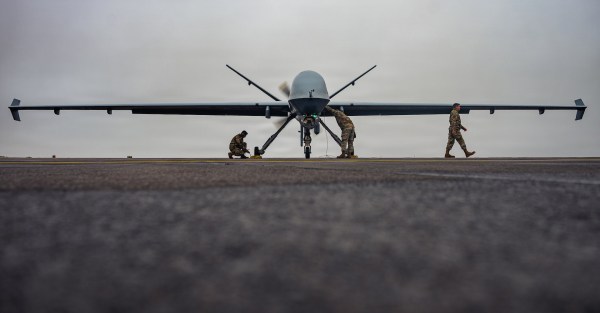
NATIONAL HARBOR, Md. — Manned fighter jets from NATO nations have recently been called upon to shoot down suspected Russian drones flying over allied territory, but the commander of U.S. Air Forces in Europe envisions a future in which that type of work could be offloaded to AI-enabled unmanned platforms.
USAFE boss Lt. Gen. Jason Hinds on Tuesday outlined “vignettes” for Collaborative Combat Aircraft employment.
“I’m excited about what CCAs have in store for the Air Force,” Hinds told reporters on the sidelines of AFA’s annual Air, Space and Cyber Conference, noting advancements that have been made in AI and the maturation of robotic fighter jet technology.
His meeting with reporters came a day after Secretary of the Air Force Troy Meink revealed that the service is aiming to field 500 CCA drones by 2032. It also came not long after an Italian fighter jet shot down a suspected Russian drone over Lithuania on Tuesday local time.
“I think you’re going to see a lot more interest from other nations inside Europe about ‘what is America doing with CCAs and how can we join this party,’ if you will. There’s a handful of nations that are already doing things,” Hinds said. “What we’re doing on the U.S. Air Force side to help them is to see how we could utilize CCAs in the European theater through a couple of vignettes. One is on a deterrence perspective to be able to augment and increase our capacity to do integrated air and missile defense, because you don’t always have to have a human in a cockpit to be able to defend against a one-way attack drone or defend against a cruise missile. You could use a CCA to be able to conduct that mission set.”
Conversely, the robo-jets could be used to take out an adversary’s air defense systems.
“One of the other operational vignettes that we’re providing for the allies is a mission set of in the event of some type of a hostile incursion into the NATO territory, and if we have to respond to be able to push a force out, we would have to be able to reduce integrated air defense systems and potentially even attack fielded forces from an opposing nation inside the European theater. There are nations that want to be able to incorporate CCAs into their air force design, their future force design … and they’re interested in using CCAs for dual roles — for defensive missions and then for things like counter-integrated air and missile defense systems,” Hinds said. “We’re helping them [think] through that.”
Hinds, who also serves as commander of NATO’s Allied Air Command, noted that the Joint Air Power Competency Centre recently produced a paper about how NATO nations could train, employ and sustain the drones and incorporate them into their force designs.
“I think you’ll start to see experimentation pretty soon. It might start in America, but I think you’ll start to see some of those things happen in the European theater,” Hinds said.
He also noted his desire to be able to take down attack drones more “efficiently” from a cost perspective.
“Primarily we’re using air power, and that’s not putting us on the right side of the cost curve,” Hinds said. “It is very effective, just like what you saw last night, and many other times. I think there’s been at least five other cases of allied nations providing air power that we need to be able to shoot down one-way attack drones. And the good thing is we’re doing it effectively. But like I said, I want to get to the point where we’re doing it efficiently using lower-cost interceptors, hopefully ground-based, and in some cases, air-based.”
Russian drone and missile incursions over NATO territory have occurred against the backdrop of the Ukraine war.
“These are limited incursions, right?” Hinds said. “Small numbers.”
“We’re not seeing a massing of forces across the opposite side of Finland, a new NATO [member] nation. We’re not seeing a massing of forces whatsoever in any domain opposite of Poland, Latvia, Lithuania, or Estonia. You’re seeing a significant number of one-way attack drones in the Black Sea targeting Ukraine — some of them are entering Romania. What you’re not seeing is a direct confrontation in geography. You’re not seeing direct competition in domains,” he added.
Hinds suggested that the Russians might be engaging in so-called “hybrid activity” against NATO that’s not intended to start an all-out war against the alliance.
“The risk about hybrid activity, from my perspective, is it could lead to escalation, and that’s where I hope that we get back towards deterrence again,” he said.