Counter-UAS task force turns to Intelligence Community for input on real-world threat assessments
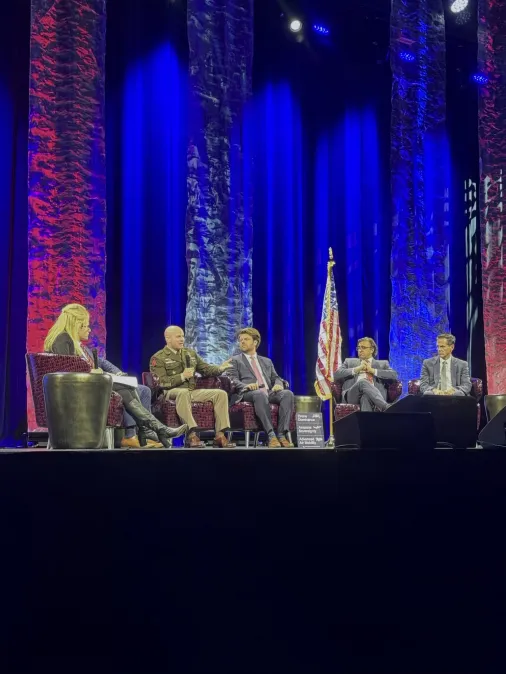
Army Brig. Gen. Matt Ross urged U.S. defense, federal and law enforcement officials to determine and describe their organizations’ unique threats and protection requirements before they move to field or buy commercial counter-drone assets from the government’s online marketplace.
During the Commercial Drone Alliance’s Drone Security Industry and SLTT Grant Forum on Monday, he and other speakers from teams supporting Joint Interagency Task Force 401 supplied updates about their ongoing work to coordinate government efforts against rising security risks from unauthorized drone incursions and related steps they’re simultaneously taking to promote aviation safety and commercial innovation.
“One thing that I haven’t talked a lot about previously is, as an interagency task force, we’ve actually tapped into the entire Intelligence Community,” Ross, who leads JIATF-401, told the audience.
The Defense Department and other federal agencies have deepened collaboration in this realm over the last few years, largely in response to surging reports about unlawful unmanned aerial systems flying or swarming near sensitive national security sites and U.S. military installations.
Set up in 2025 by the second Trump administration, JIATF-401 is a Pentagon-led team that’s synchronizing counter-UAS initiatives, policies and procurements across DOD and with its interagency partners.
“I love the progress that we’ve made over the past 12 months. I look around the room here and I see state, local, tribal, territorial law enforcement that’s energized and focused on the problem. We have a training pipeline. We have all these good things. But it’s really easy for us to confuse a sense of vulnerability with a sense of threat,” Ross said at Monday’s forum. “And so the first question I always ask — and it’s the first question I’d be asking if you’re a recipient of the [Notice of Funding Opportunity, or] NOFO — is: ‘What is my threat? What do I actually need to be able to protect against [and where]?’”
That information, in his view, is critical for counter-drone providers to ensure they are building the appropriate tools that target real-world, ever-changing UAS threats.
Ross also said that JIATF-401 is working to “provide greater specificity” when defining counter-drone needs across a sprawling landscape of military and government components.
“We’ve asked the Intelligence Community for authoritative assessments of what we should be thinking about — both at home and abroad,” Ross said.
He didn’t share additional details about the task force’s budding partnership with the IC.
In response to questions on Thursday, Lt. Col. Adam Scher, JIATF-401’s strategic communications advisor, said the military-led team has been working closely with the Office of the Director of National Intelligence and the broader IC “to continuously assess the battlefield, analyze adversary tactics and employment, and anticipate evolving threats.”
“Understanding the threat is fundamental to understanding what our warfighters need to defend the homeland. There is no one-size-fits-all solution,” Scher told DefenseScoop. “What works in Alaska may not work in Arizona; what is required to protect an Army barracks may differ significantly from the requirements of an airfield or runway.”
He said JIATF-401 takes “a mission-focused approach by tailoring solutions to the operating environment, mission requirements, and specific threats.” Collaborating closely with the Intelligence Community, he added, helps the team ensure their work is informed “by the latest intelligence and deliver the most effective tools and technology to our warfighters.”
Meanwhile, on Monday’s panel, Ross and officials from other agencies supporting the joint task force also discussed the new memorandum of understanding that streamlines the government’s rules and processes to test and deploy counter-drone tech to protect America.
According to Liam McKenna, who serves as the Federal Aviation Administration’s chief strategy officer and acting deputy administrator, the MOU has not been approved for public dissemination, and its text must be requested through the Freedom of Information Act (FOIA).
“And then we’ll have to determine how public it actually is, and we’ll deal with that when we get there,” McKenna said. “But broadly, it’s dealing with the different roles each department and agency plays, and the process for conducting these safety risk assessments — what we need from the departments and agencies that are submitting technologies to us.”
The memo was signed by the departments of Defense, Transportation, Homeland Security, Energy and Justice, and applies to their components, including the FAA and FBI.
McKenna said the document covers “the coordination process for reviewing” counter-UAS systems as they are increasingly adopted and safety risk assessments are conducted.
He noted that there will eventually be an interagency “approved technologies list” based on the reviews.
“It’s not something that the folks out here are seeing a lot of. But it’s something that enables us all to be coordinated, to be agile, to be adaptive, to make sure that the systems we’re using are safe, and also to conserve resources,” McKenna said. “So if FAA’s looked at a system for [the DOD] and then DHS wants to buy the same system, we’re not repeating this all over again. We’ve seen the system, we can probably approve it and reach an agreement on its use within 24 hours in many cases.”
FedScoop reporter Lindsey Wilkinson contributed reporting.