DOD moves to make its largest-ever investment in drones and anti-drone weapons
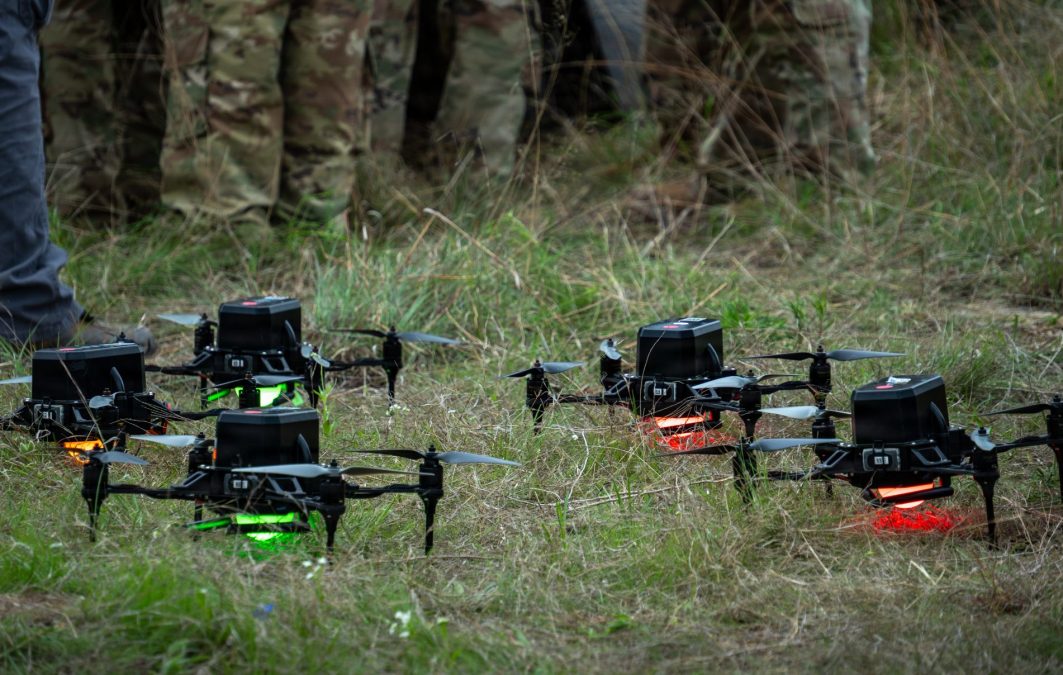
The Trump administration’s spending plan for next year allocates more than $70 billion for military drones and counter-drone weapon systems, according to two senior defense officials who said that proposed funding surge would mark the Pentagon’s most substantial investment in the technologies to date.
On Tuesday, Jules “Jay” Hurst III, the official performing the duties of comptroller and undersecretary of defense, and Space Force Lt. Gen. Steven Whitney, director for force structure, resources and assessment, briefed reporters on the Defense Department’s fiscal 2027 budget request.
In it, the Pentagon asks Congress to approve $1.5 trillion in total funding — $1.15 trillion through its yearly appropriations process, and $350 billion via the legislative tactic of reconciliation.
“Drone warfare is rapidly reshaping the modern battlefield, and this budget is the largest investment in drone warfare and counter-drone technology in U.S. history,” Hurst said. “Manned-unmanned teaming is the future of combat, and this budget makes it a reality.”
Specifically, he noted that the department is “requesting $53.6 billion for autonomy, drone platforms and contested logistics, along with $21 billion for munitions, counter-drone technologies and advanced systems like the collaborative combat aircraft.”
In comparison, Pentagon officials sought $13.4 billion for autonomous systems and $3.1 billion for counter-drone capabilities in fiscal year 2026, which also reflected a major increase from years prior.
Over the last decade, unmanned platforms have emerged as game-changing weapons in modern combat, and urgent and enduring threats to U.S. military personnel, base security and national security.
Low-cost drones are saturating international markets as America pivots to better protect its domestic infrastructure from a rise in risky, adversarial drone incursions. Drone swarms and other, related deadly tactics are also being observed in real-world conflicts around the Middle East and elsewhere.
At the Pentagon briefing, Whitney said there is a growing need for the joint force to purchase and adopt drone and counter-drone assets that he said are now evolving “in a timeframe of weeks, not the typical years that we see with our defense production.”
“We look at that as a capability that’s necessary, that we’ve seen in the battlefields,” Whitney told DefenseScoop. “If you look at what’s going on in Ukraine and their ability to have drone-on-drone type warfare — and the ability to do so at cost and scale — it’s really something that we need to figure out how to take advantage of to protect our force.”
The Pentagon is expected to release additional budget materials on a rolling basis in the days ahead.
A document that outlines broad investments across DOD’s research development, test and evaluation programs notably reveals a colossal, more than 24,000% boost for the Defense Autonomous Warfare Group (DAWG) — from $225.9 million received in fiscal 2026 to up to $54.6 billion requested in fiscal 2027.
Pentagon officials have been tight-lipped about the DAWG’s progress and functions since it was established in 2025.
At the time, it was billed as a specialized, high-level team that was launched as a successor of the Biden-era Replicator initiative to facilitate the department’s accelerated plan to purchase and deploy thousands of attritable drones.
“I think of the DAWG as a pathfinder. They’re out there finding the best technology for us and working on integration. They’re with these companies live, right now, testing different systems and orchestration tools for autonomy, and they’re giving them live feedback,” Hurst said at Tuesday’s briefing. “So it’s a very agile process, and a lot of the programs themselves will be executed with the services.”
Whitney added that it makes sense to fund the DAWG with “research and development-type money” based on federal regulations, because the hub is focused on enabling “incremental capability.”
“You’re talking about innovation in terms of weeks and the ability to spin and develop new capabilities — that’s really what we are. It’s not that you’re buying one set baseline and you’re going to procure it forever,” he said. “You can buy items with research and development, but you just typically don’t buy a large lot of one particular thing.”
The officials indicated that while the general DOD funding will increase by a proposed 22.6%, the budget request also includes a “presidential priorities category” for investments in Golden Dome, the Drone Dominance Program, artificial intelligence and data infrastructure, as well as the U.S. defense industrial base.
“That $70 billion [for drones and counter-drone capabilities] is all going into existing systems and technologies. The industrial base support is entirely separate. Obviously, when you buy vast quantities of something, you stimulate the industrial base, but that is a focused effort on actually fueling technology and applying existing technology in a way that’s useful to the warfighter,” Hurst told reporters.