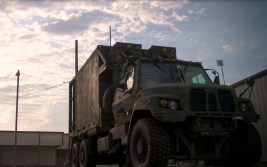
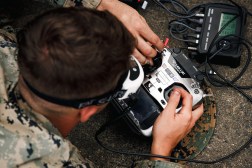
Marine Corps awards Anduril nearly $16M for Pulsar-Lite EW system to counter drones
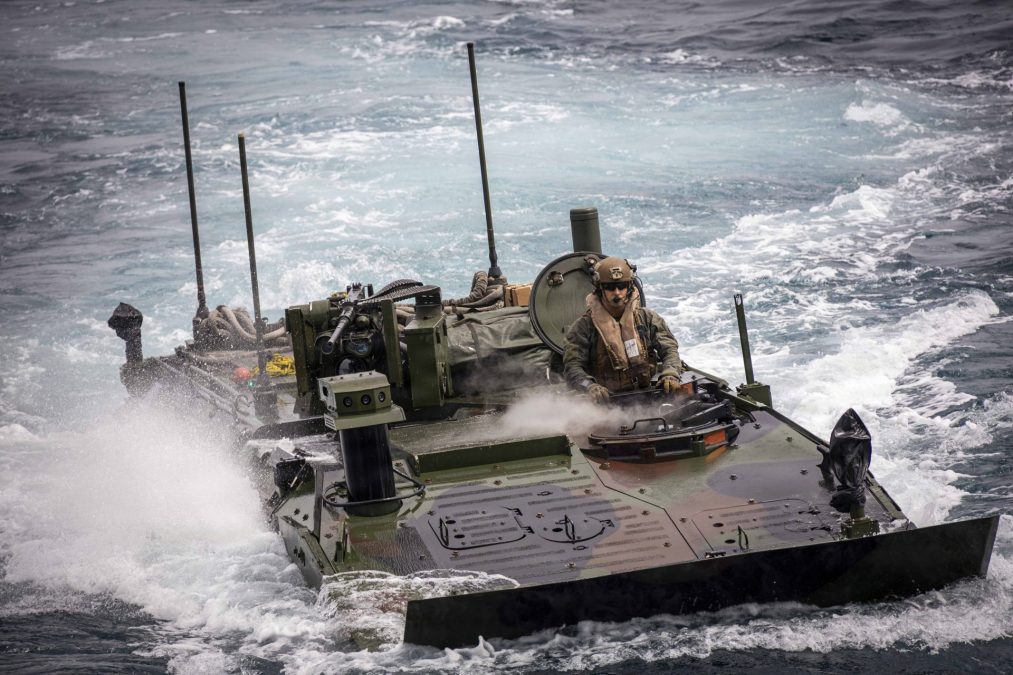
The Marine Corps awarded $15.7 million to Anduril for its Pulsar-Lite electronic warfare system, according to a recent public notice, fulfilling a sole-source purchase the service was eyeing for months over an “urgent need” to equip its amphibious vehicle fleet with drone-zapping technology.
Anduril unveiled the Pulsar-L last spring, billing it as a compact version of its family of EW systems capable of detecting and defeating drones, including swarms. By the following June, the Marine Corps announced its intention to negotiate a sole-source award with the company, citing the Pulsar-L as an “urgent requirement.”
The Marine Corps made that purchase earlier this month and plans to integrate an unspecified number of Pulsar-L systems into its Amphibious Combat Vehicle fleet at a time when armored vehicles have proven vulnerable to drone attacks and as the electromagnetic spectrum becomes an increasingly important factor in modern combat.
“The Marine Corps urgently needs a [counter-unmanned aerial system] capability for the ACV to ensure its survivability in the modern battlefield environment,” officials wrote in the notice. The Pulsar-L “will provide the ACV with an essential defensive capability, directly contributing to increased survivability and force protection while not sacrificing the mobility and operational tempo of the ACV.”
Anduril will begin delivering the Pulsar-L systems to the Marine Corps in January, according to the notice, which said that U.S. Special Operations Command was currently using it.
The company said the capability can connect with multiple EW systems “to deliver coordinated effects,” geolocate electronic signals and operate autonomously. Officials from all services have emphasized that electronic targeting has wrought risks and rewards on the modern battlefield, where even the smallest signals can become fodder for near-immediate targeting.
The Marine Corps said that the system’s sensor-jammer combo could defeat Group 1 and 2 drones, systems that have also proven uniquely deadly to armored vehicles during the war in Ukraine. DefenseScoop previously reported that the service was proliferating its counter-drone system stable, as the other services are rushing to do, and pushing those capabilities down to the small unit level.
The War Zone first reported the award notice on Friday.
Critical for the Marine Corps, officials said in the notice, the Pulsar-L was the “only solution” capable of being mounted on the ACV without exceeding the vehicle’s limited space, weight and power requirements.
The ACV made its first overseas debut during a training exercise in 2024. A replacement for a decades-old vehicle, the ACV is wheeled and comes in four variations, its most common being a personnel carrier critical to the Marine Corps’ mission of transporting troops from ship to shore.
DefenseScoop reported in January that the Marine Corps was already looking to replace the struts on all of its ACV fleet because of ocean-water corrosion and extensive use.