The missing puzzle piece in space superiority: Why it’s time for the U.S. government to prioritize VLEO
Over the past decade, the United States has come to recognize that space is no longer a sanctuary. China and Russia are developing weapons to disrupt, disable and destroy American satellites. The Space Force now talks openly about weapons in space, orbital warfare, and space superiority. Just last month, Air Force Secretary Troy Meink stated for the first time that the Space Force “has on-orbit space control weapons capable of defending the Joint Force against hostile adversary action.”
Government funding has followed. The Space Force’s fiscal 2027 budget request, at $71.1 billion, is a 124% increase from fiscal 2026 and the largest percentage increase for a service since 1952. Hundreds of new satellites are being deployed to make American space architecture more distributed and resilient, while the Space Force explores new concepts focused on making space operations more agile, proliferated, and intelligent. With space more accessible and affordable, the Space Force and commercial companies alike are proliferating the vast majority of new satellites to Low Earth Orbit (LEO), which demands large numbers of spacecraft for persistent coverage over a given region.
But this space superiority strategy does not account for the most significant threat in space: a nuclear detonation that makes all of LEO unusable for up to a year.
This is not a hypothetical risk. In 2022, Russia deployed a test-bed satellite to learn how it could deploy a nuclear weapon in space. Two years later, the Pentagon confirmed that Russia was developing an “indiscriminate” nuclear weapon to deploy in LEO. And in March of this year, Gen. Stephen Whiting, commander of U.S. Space Command, called the prospect of a nuclear weapon on orbit the “single greatest threat to our space architecture.”
For all the attention Washington rightly devotes to jamming, cyberattacks, rendezvous and proximity operations, conventional anti-satellite weapons, and a responsive space industrial base — none could counter this single greatest threat.
A nuclear detonation in LEO, where most satellites today reside, would do more than destroy satellites in the immediate line of sight. It would inject high-energy electrons into Earth’s magnetic field, creating artificial radiation belts that persist for up to a year. Most commercial-style LEO satellites, designed for the natural radiation environment, would begin failing in days or weeks. The space industry would largely ground to a halt.
The United States is investing heavily in the ability to manufacture and launch replacement satellites quickly — an effort known as “Tactically Responsive Space” (TacRS). But after a high-altitude nuclear event, newly launched conventional LEO spacecraft would encounter the same radiation environment that destroyed their predecessors. The underlying radiation can persist on roughly year-long timescales: one recent Atlantic Council analysis cites particle diffusion approaching 300 days in LEO. Building more satellites faster will not provide resilience when those satellites do not have a survivable orbit to deploy to.
The good news is that the U.S. has an alternative: building infrastructure in a lower, more resilient orbit.
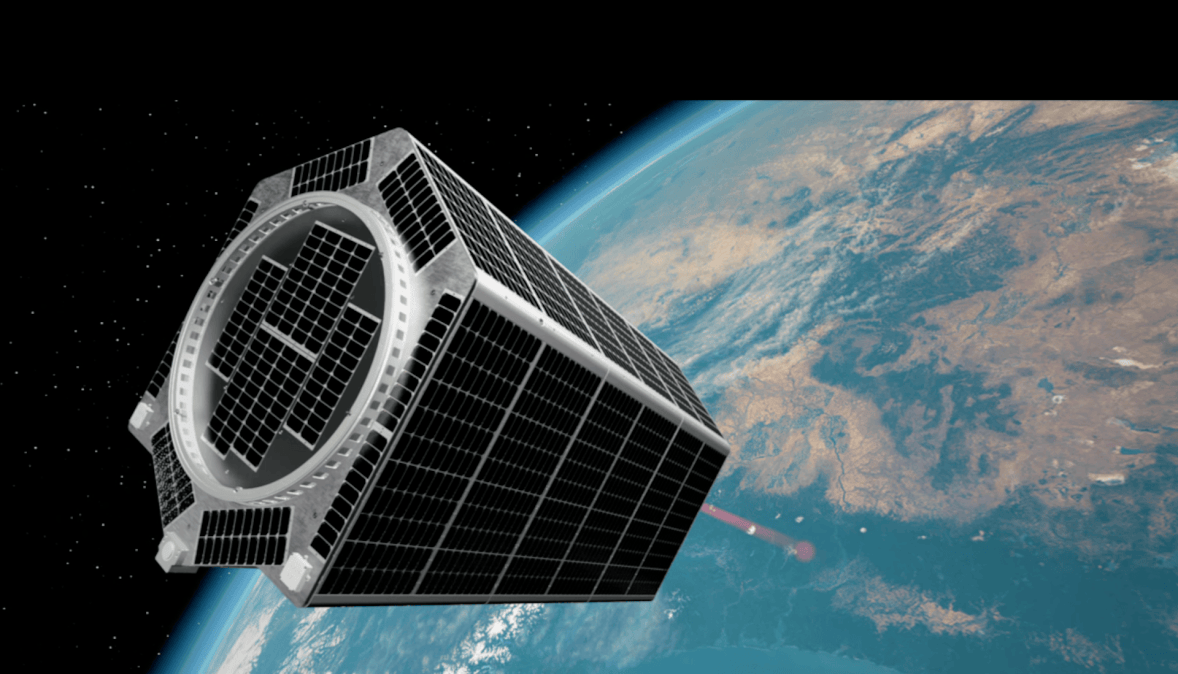
Very Low Earth Orbit (VLEO) generally refers to the region below roughly 350 kilometers, and the most interesting survivability benefits appear around 300 kilometers and below. At these altitudes, the Earth’s atmosphere is dense enough to absorb the harmful radiation, a natural shield for satellites flying in VLEO.
A nuclear detonation could still destroy some satellites within line-of-sight of the immediate detonation, but VLEO would largely remain reusable after an attack. Surviving satellites could continue operating, and replacements can be launched without waiting months for an artificial radiation environment to subside.
Despite the fact that VLEO could de-risk the most significant threat to space operations, the Space Force and Intelligence Community have not historically paid nearly as much attention to it. The U.S. government has invested a few million dollars into R&D projects but very little relative to larger space expenditures. In his first major remarks as chief of space operations, Gen. Douglas Schiess described the Space Force’s mandate as protecting space “from low Earth orbit all the way out to cislunar space,” leaving out VLEO.
China recognizes the advantages of VLEO. Its state-owned aerospace industry is pursuing a planned 300-satellite VLEO remote-sensing constellation by 2030, and in June China formed a 34-member VLEO technology and industrial alliance to coordinate research, standards and commercialization. Public reporting on China’s Chutian constellation describes plans for optical, radar, hyperspectral and infrared sensing from below 300 kilometers. This commitment to VLEO dwarfs that of the U.S. While China’s future proliferation of VLEO is not the only reason to act, it compounds the risk of the U.S. losing LEO in a conflict, as China would have an asymmetric, survivable orbital layer.
The Space Force and Intelligence Community should treat orbital diversity the same way military planners treat geographic diversity. We would never place every critical aircraft at one air base simply because that base was highly defended. Yet an enormous share of U.S. communications, sensing, missile warning, targeting capability, and exquisite satellites is concentrating in broadly similar LEO environments.
A VLEO layer could replicate a subset of the most essential missions — targeting and damage assessment, intelligence and surveillance, tactical communications, missile tracking and space-domain awareness — so that losing access to conventional LEO would not mean losing those capabilities altogether. Beyond redundancy, flying below other satellites offers a useful vantage point for sensors looking upward into LEO. And proximity to Earth brings secondary advantages including stronger signals, higher imaging resolution and lower communications latency. While higher orbits like Medium Earth Orbit (MEO) and Geostationary Orbit (GEO) also offer redundancy, they lack the same cost advantages of deploying to LEO or VLEO, as well as the advantages in resolution and latency that are inherent with proximity to Earth.
VLEO technology is much less speculative than it was a decade ago. This orbit imposes punishing atmospheric drag and atomic-oxygen exposure, which has historically made long-duration operations difficult. Commercial flight demonstrations, including just last year from Albedo (a Shield Capital portfolio company), have now validated key technologies for sustained operations in the regime at a price point that is competitive with LEO offerings and much less expensive than MEO or GEO. Meanwhile, DARPA is developing new propulsion approaches that will make VLEO even more tractable.
To their credit, Space Force officials are beginning to recognize the opportunity. Deputy Chief Science Officer Gillian Bussey recently described VLEO as a way to create a “resilient and survivable architecture” and suggested rapidly deploying proliferated VLEO systems after losing imaging or communications satellites elsewhere. The service plans to further develop its VLEO architecture plans in the next year.
Additionally, the White House has now set the direction for VLEO. A December executive order explicitly directed the government to ensure the ability to address threats from VLEO through cislunar space, including nuclear weapons, while creating a more responsive and adaptive national-security space architecture. Statements like these are early signals that the U.S. government wants to make VLEO a core part of its strategy for space superiority.
If the U.S. fails to prioritize VLEO imminently, it would not be the first time Chinese industrial policy spent years building advantages in technologies Washington regarded as interesting but strategically secondary. By the time inexpensive Chinese drones became indispensable on battlefields around the world, DJI already dominated the market. To this day, U.S. and Ukrainian drone supply chains are critically dependent on China, which is also directly and indirectly supporting the Russian military.
We are at risk of making a mistake in VLEO that could have similar consequences.
The Space Force does not need to move everything into VLEO. It needs to ensure that the U.S. can maintain critical operations from space even if it loses access to LEO. That means identifying the missions that must survive even if conventional LEO becomes temporarily inaccessible, funding VLEO spacecraft and constellations, establishing operational experience, and building a domestic industrial base for production capacity.
The U.S. cannot achieve space superiority if it ignores the largest threat to an indispensable orbit. Space superiority means retaining essential capability after an adversary tries to destroy it. VLEO is a challenging but proven orbit, and the Space Force’s investments should reflect its importance.
David Rothzeid is a Principal at Shield Capital, an early-stage venture fund focused on the intersection of national security and commercial capability. He served in the United States Air Force as an acquisition officer for over a dozen years and is currently a reservist at the Pentagon.
Matt Kaplan is an Associate at Shield Capital.