UAS is ‘the new’ IED: Hung Cao urges industry to innovate faster against modern drone threats
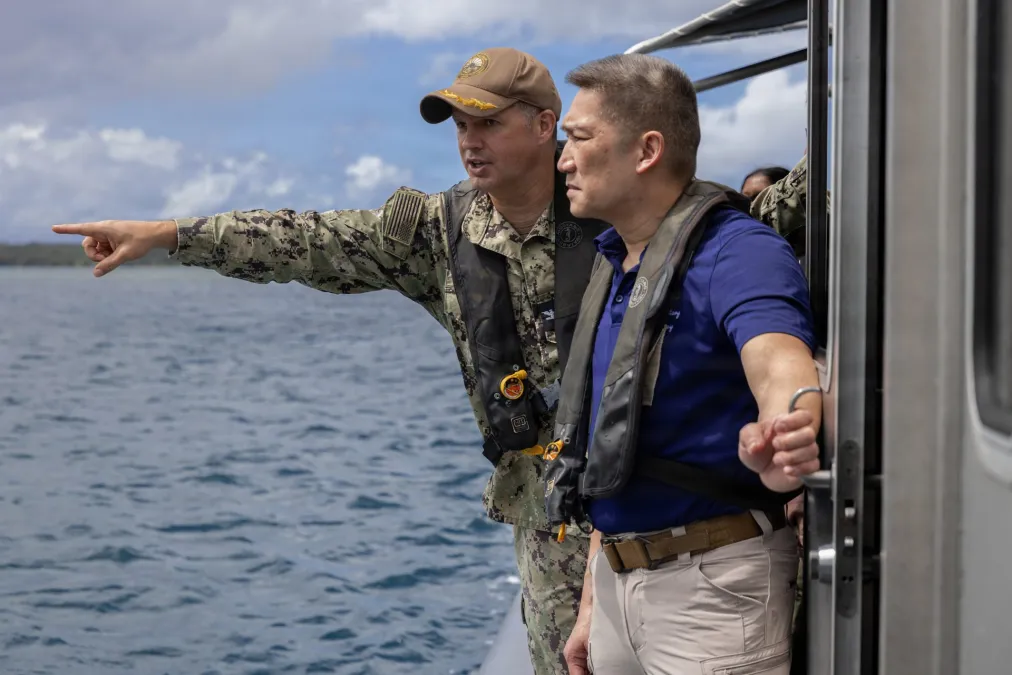
The Navy’s new acting secretary, Hung Cao, urged industry officials to speed up the delivery of high-quality counter-drone systems and other AI-enabled military assets to protect and better equip sailors and Marines who are deployed overseas.
“What you’re producing right now is going to save the lives of America’s sons and daughters. My son, who’s going to be commissioned as a second lieutenant in about 24 days. So, that’s why I do what I’m doing, because I’m not going to have my son go to war the way I did when we were invading Iraq. We didn’t have the right equipment,” Cao said Tuesday at the Modern Day Marine conference. “That’s why I’m here today — to tell industry we need to move forward. The time is now. This is the time for us to do generational changes for our military.”
This keynote marked Cao’s first high-profile public address since he was appointed to lead the sea service on April 22, after the swift and surprising removal of John Phelan by Defense Secretary Pete Hegseth and President Donald Trump.
“My life changed a little bit in the last six days,” the new acting SECNAV told the audience. He said he was prepared to take over, though, “because in combat, you lose people, and the fight goes on.”
Cao was born in Vietnam, but fled that wartorn country with his family as a young child in a wave of refugees.
The retired Navy captain spent much of his long military career as a special operations officer who specialized in explosive ordnance disposal and deep-sea diving.
Cao deployed to Iraq, Afghanistan, Somalia and elsewhere. He is also known for his contributions on the dive team that recovered John F. Kennedy Jr’s remains after his plane crashed in 1999.
During his time as the Navy’s top civilian leader, Cao said he wants to see more competition among industry players and new companies entering the mix to inject innovation and capacity into key priority areas within the U.S. military arsenal, like munitions, unmanned aerial and maritime systems, and AI.
“We need AI to get faster, better, smarter — whether it’s in ship repair, or ship maintenance, or just help us make that decision. I mean, you’ve got all these missiles, for example, on a ship. How do you know which [one is best to use]? Sometimes you’ll need that AI in order to make that better decision in that quick, quick reaction, because you only have a few seconds — especially when you’re talking about a lot of the drones and the cruise missiles that are coming in at the same time,” Cao noted.
Drawing on his combat deployments in the Middle East in the early 2000s, when improvised explosive devices and roadside bombs represented the deadliest threat to U.S. forces, Cao said counter-UAS is now “the new” counter-IED.
“I’ve taken care of the IEDs on the battleground, as an EOD technician. And this is their IED. It’s flying, it’s doing all sorts of stuff. It can drop chemical, biological weapons if they want it to. And this is what our next-generation fight is going to be,” Cao said. “So, we need to bring the fight to the enemy with our own drones and be able to master the ability to counter these drones [with] everything we need in order to make the Marine unit on the ground safe.”
His tenure comes as the Navy is armed with new “Fighting Instructions” to modernize its warfighting approach to meet the demands of the modern era. The service is hustling to enable a hybrid, “Golden Fleet” that integrates AI and robotic platforms with traditional manned ships to solve specific, complex operational problems.
“The Golden fleet is not just about ships — it’s the whole concept of reforming acquisitions,” Cao said.
He encouraged industry insiders to help build out a “high-low mix” of platforms for the Navy, including frigates, destroyers, larger combatants, drones, next‑generation aircraft and connectors, and other maritime assets.
Cao previously served as the undersecretary of the Navy. Before that, he ran for federal office on the Republican ticket in Virginia in 2022 and 2024. He lost both races.
Re-emphasizing comments he made during his time on the campaign trail, Cao also told the audience Tuesday that he doesn’t “need cross-dressers in the military.”
“I need alpha males and alpha females that are going to rip out their guts and eat them and ask for seconds. Those are men and women that are going to win wars — and that’s what we need. I don’t need leaf eaters, okay. If you’re a leaf eater, go somewhere else. We need meat eaters,” he said. “Look, we’re at war right now. I’m a war secretary. I’m a secretary during a time of war. I’ve been there. I’ve eaten the same dirt. I’ve been in the same crappy places you have, and I will do everything I can to make sure you don’t have to go through the things I did. You have my word of it.”