Navy conducts first test flight of MQ-25 tanker drone
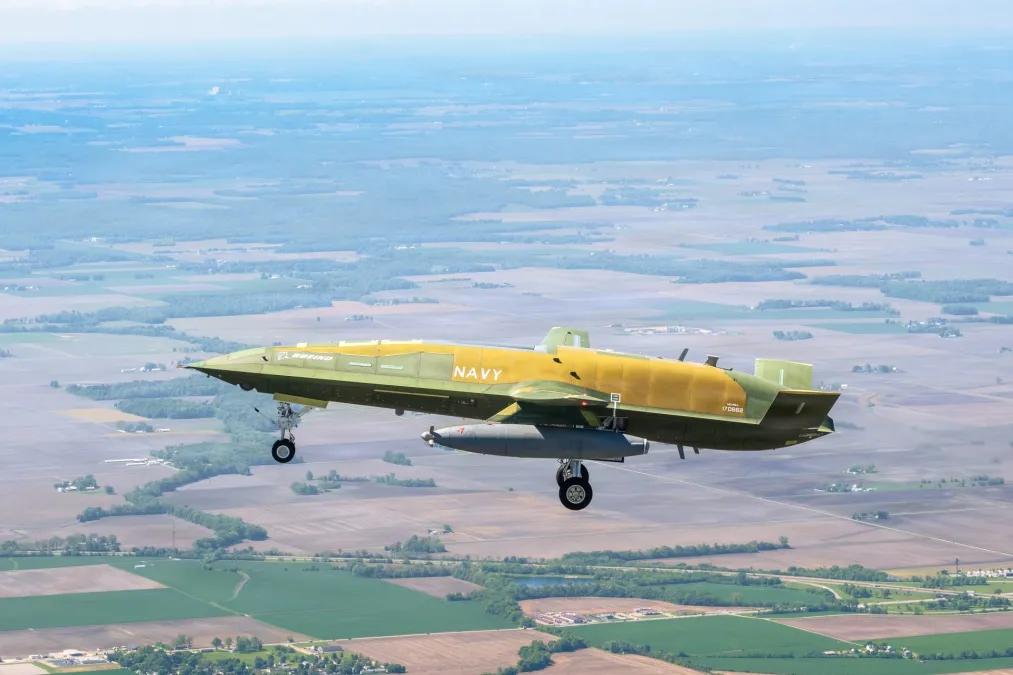
The Navy has successfully completed the highly-anticipated maiden flight of Boeing’s MQ-25 Stingray, a critical milestone for the service’s effort to field its first aircraft carrier-based unmanned aerial vehicle.
The test flight occurred Saturday at MidAmerica St. Louis Airport in Illinois, where the MQ-25 took off and flew for about two hours while executing various maneuvers and tests, according to a Navy news release. The flight validated the drone’s basic flight controls, Unmanned Carrier Aviation Mission Control System MD-5 Ground Control Station (GCS) and performance of the Rolls-Royce AE 3007N engine.
“Achieving this first flight underscores the strong partnership between the Navy and our industry partners,” Rear Adm. Tony Rossi, the Navy’s program executive officer for unmanned aviation and strike weapons, said in a statement. “The MQ-25A is not just an aircraft: it’s the first step in integrating unmanned aerial refueling onto the carrier deck, directly enabling our manned fighters to fly further and faster.”
Specifically designed as a tanker drone, the MQ-25 will relieve the Navy’s F/A-18 Super Hornet fleet from the aerial refueling mission — freeing the fighter aircraft for more pressing roles. The service also anticipates the Stingray will conduct intelligence, surveillance and reconnaissance operations.
The Navy awarded Boeing an $805 million contract in 2018 to build and deliver the MQ-25. The company first began flying a demonstrator of the drone — known as the T1 — in 2019 in order to prove the concept of unmanned aerial refueling.
The service initially expected to hold the first flight of a production-representative MQ-25 before the end of 2025, but was forced to delay the test to early 2026 to conduct additional ground tests and certifications.
During its maiden flight, the MQ-25 demonstrated its ability to autonomously taxi, take off, maneuver and land — all while responding to commands from operators on the ground. The test also validated the drone’s flight controls, navigation capabilities and integration with the GCS, according to officials.
“Today’s successful flight builds on years of learning from our MQ-25A T1 prototype and represents a major maturation of the program,” Dan Gillian, vice president and general manager of Boeing Air Dominance, said in a statement. “The MQ-25A is the most complex autonomous system ever developed for the carrier environment, and this historic achievement advances us closer to safely integrating the Stingray into the carrier air wing.”
The MQ-25 is powered by Rolls-Royce’s AE 3007N engine, a derivative of the company’s propulsion system already integrated onto a number of other military and commercial aircraft. The engine’s architecture enables reduced fuel consumption that will be critical for the drone’s long-endurance flight times, according to the company.
“The Rolls-Royce AE 3007N engine was integral to the successful first flight of the MQ-25A Stingray, which will greatly enhance the range and capability of the U.S. Carrier Air Wing,” Meagan Rater, the company’s director of U.S. mature programs for defense, said in a statement. “We continue to work closely with the U.S. Navy and Boeing to make the MQ-25A a reality for our service members, giving them a key strategic advantage in contested environments.”
Saturday’s flight test also demonstrated the Navy’s Unmanned Carrier Aviation Mission Control System MD-5 GCS — the service’s new ground-based command-and-control station designed specifically for carrier-based unmanned aircraft. Lockheed Martin is providing its MDCX software to serve as the backbone of the GCS.
Moving forward, the Navy will continue the MQ-25’s integration with the ground control stations while expanding and verifying its flight envelope, the service said in a statement. The drone is expected to move to Naval Air Station Patuxent River in Maryland by the end of 2026 to prepare for carrier-based flight tests.