After Valiant Shield exercise, PACAF commander says he’s ‘impressed’ with Australia’s Ghost Bat drone program
On the heels of a large multinational exercise, the commander of U.S. Pacific Air Forces said he’s “impressed” with the Royal Australian Air Force’s collaborative combat aircraft program.
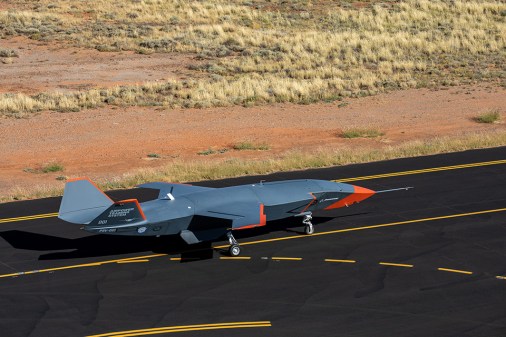
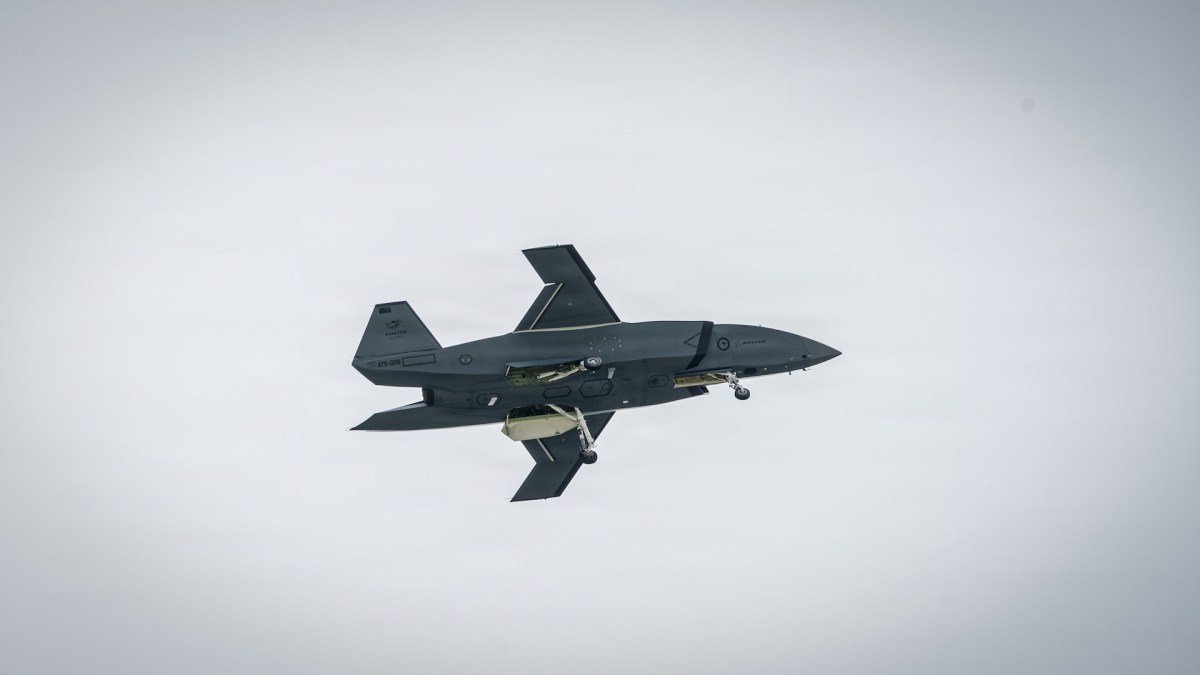
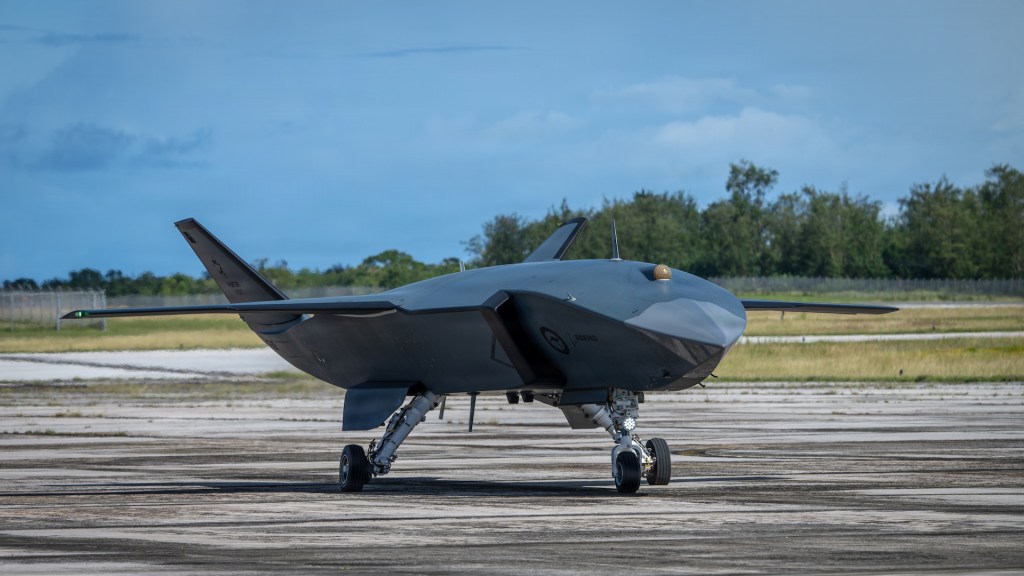
A production representative MQ-28 Ghost Bat drone, built by Boeing, was integrated into the recently concluded Valiant Shield 26 event in the Pacific, which was led by the United States and included participation from Australia, Canada, Japan and New Zealand.
“For the first time in a major international exercise, the Boeing Defence Australia MQ-28A Ghost Bat demonstrated how collaborative combat aircraft can integrate, enhance and complement other platforms,” officials wrote in an Australian Defence Department press release.
The platform has a range of 2,000-plus nautical miles and “fighter compatible speeds” of up to Mach 0.9, according to a Boeing list of product specifications.
During Valiant Shield, the jet-powered drone flew alongside a manned U.S. Air Force F-15EX Eagle II aircraft and participated in “agile combat employment” operations in the Northern Mariana Islands, according to the release.
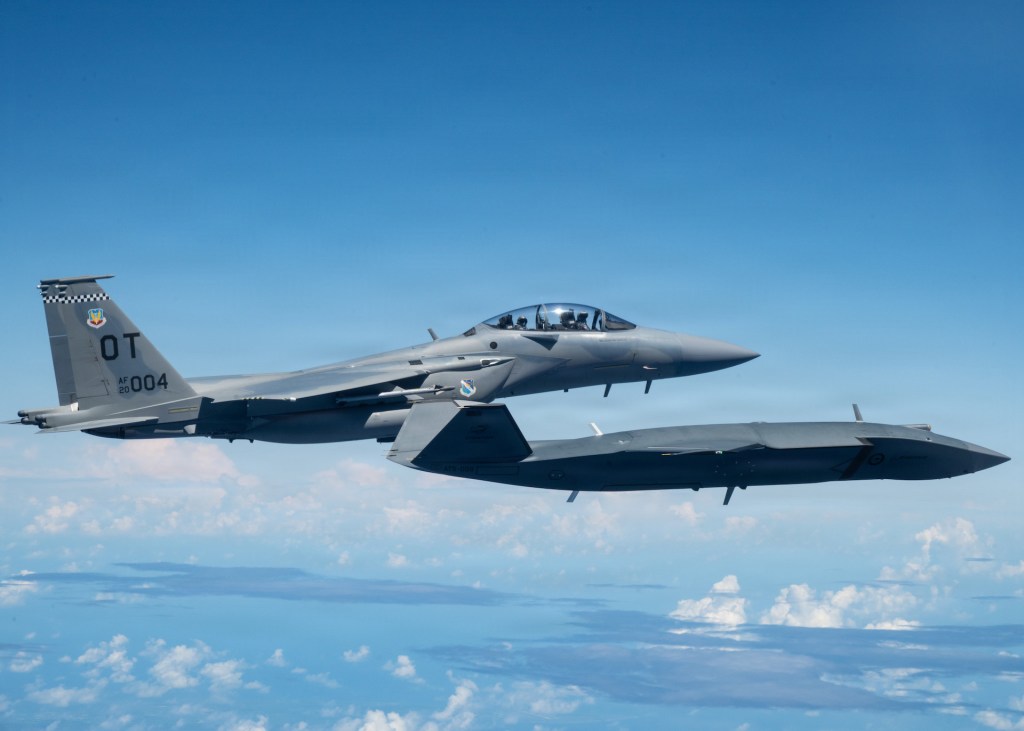
The Ghost Bat was expected to perform a variety of missions during the exercise, including defensive and offensive counter-air missions, according to a separate PACAF press release about the event.
“I’m really impressed with how that program, the Ghost Bat program, is going and what it sets as an example for others that are going down this road with CCAs,” Gen. Kevin Schneider, head of Pacific Air Forces and the air component of U.S. Pacific Command, said Monday during a webinar hosted by the Mitchell Institute for Aerospace Studies.
AI-enabled collaborative combat aircraft are expected to serve as loyal wingmen for manned military planes, and also have the ability to perform operations independently.
The U.S. Air Force has its own CCA program. Last month, the service announced that Anduril and General Atomics received production contracts for Increment 1 of the project, and Anduril, Shield AI and RTX subsidiary Collins Aerospace were selected to move into the next phase of the mission autonomy software effort.
The CCA initiative recently achieved a major milestone after the execution of a live-fire test in which Anduril’s YFQ-44A Fury drone launched an AIM-120 missile at a digital target.
Meanwhile, Schneider said he’s receiving “constant updates” from RAAF leadership on the Ghost Bat program and how the Australians are looking to integrate that capability.
“Grateful that we were able to incorporate some of this in Valiant Shield, or to be a part of it. I’d say most of the interaction in Valiant Shield was within our test community, and the experimental operations squadron that we have looking at U.S. Air Force CCA platforms was really threaded in tight with what the Australians were doing. So, the crossflow of information within the test and development effort is really strong. You know, as that continues to play out and evolve, then we can start looking at, you know, operator to operator between the RAF and the PACAF and USAF to look at command-and-control architectures, authorities, [and] exactly … how we would use this,” he said.
CCAs are seen as a cost-effective means of boosting the Air Force’s fighter capacity while keeping service members out of harm’s way.
However, it may be a few years before the U.S. military fields CCAs in the Pacific or elsewhere.
“I am somewhat trapped in the present and the here and now,” Schneider told DefenseScoop during Monday’s webinar when asked how PACAF is laying the groundwork for the incorporation of the next-generation drones into its forces. “My sight picture is from today to about three to five years in the future. And where CCAs are sitting right now in terms of their development, that’s kind of the edge of my radar scope. But Headquarters Air Force is thinking long and hard about this, and especially as they look at future design for the U.S. Air Force.”
He noted that officials are pondering what will be needed for Increment 2 of the CCA program and how these capabilities could be incorporated into the fleet.
“I absolutely do … see, you know, value and opportunity,” Schneider added. “There’s discussion about, you know, what are the specific use cases and how we would employ them.”