Back from Ukraine support mission, Army signal officers say service still needs to shed old GWOT spectrum mindset
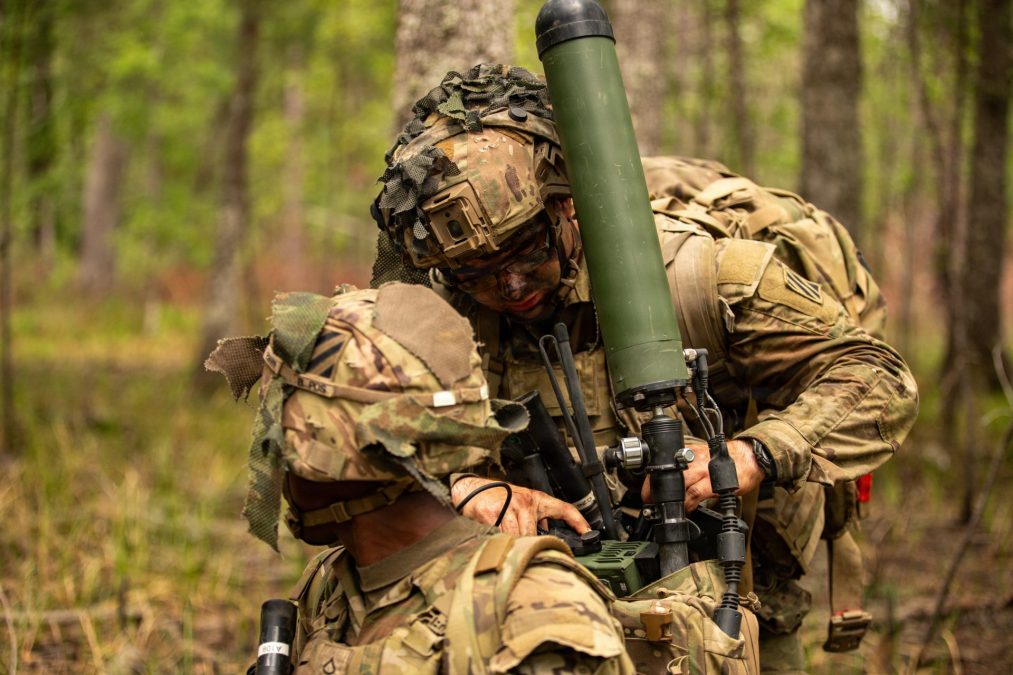
AUGUSTA, Ga. — Straight from tours supporting Ukraine’s fight against Russia, U.S. Army officers presented their latest assessment of just how deadly electronic warfare has become, where virtually every emission can be detected and targeted within minutes.
They added fresh entries to the catalog of concerns about the American military’s ability to operate in such a conflict, and argued that because nearly every mission must now consider the electromagnetic spectrum, the service’s signal soldiers must become some of the most tactically proficient members of the modern battlefield.
While the officers said the Army was making improvements and they were confident it could adapt to that type of environment quickly, their remarks about signature management, data flows, access to new technology, training and shedding outdated Global War on Terror mindsets come as the military just begins to reckon with the reality of a contested electromagnetic spectrum.
“In the same way that Ukraine experienced friction converting senior leaders from a Soviet-era mindset that is more centralized to the Western approach to war, there are leaders in our own formations who are still anchored in a spectrum-permissive counterinsurgency mindset from the 2010s,” Capt. Josiah Turner, a signal officer, told an audience at the TechNet Augusta conference on Tuesday.
Turner and 1st Lt. R. Forrest Ansell Jr., a prior-enlisted signal officer, recently served in advisory roles for the Security Assistance Group-Ukraine, a Germany-based, U.S.-led organization founded after Russia’s invasion in 2022 that oversees support for Kyiv.
Parts of SAG-U are being absorbed into a separate, Ukraine-oriented NATO command that will find itself without an American commander next year, military officials announced earlier this month, instead installing a Canadian or European commander as the Trump administration compels regional countries to take on greater responsibility for the continent’s security.
While they made no mention of it, the officers’ comments also come amid the Iran war, now in its sixth month, which has tested the U.S. military’s ability to manage its electronic signature at a much smaller scale than that playing out in Eastern Europe.
Even before Russia’s full-scale invasion of Ukraine, senior leaders had warned that the American military was behind in the electromagnetic spectrum.
Now, and over the course of nearly a year, the Army has worked to develop its Next Generation Command and Control network, or NGC2, a burgeoning ecosystem of hardware and software the service says can securely transfer data across a future contested battlefield so commanders can make faster, better decisions against a sophisticated enemy.
The signal officers relayed what such a future might look like.
They described the network of sensors and drones hunting for dug-in Ukrainian command posts and tactical-level units that are constantly needing more bandwidth than common commercial transports can typically offer.
The proliferation of drones down to lower-level units and the abundance of sensors has Ukrainian soldiers producing more than 600 terabytes of data every day, Ansell Jr. said, which puts a heavy demand on the network and requires them to rely on AI to analyze heaps of information human analysts simply cannot assess quickly enough.
They echoed concerns from senior Army officials about bygone eras of comparatively untouched medical evacuations, the difficulties infantry and armored units will face trying to move across a drone-saturated battlefield, and the need for industry to quickly develop capabilities that can connect across commercial-forward and legacy systems alike.
But the junior officers also offered finer details to several of those conversations, acknowledging that while military culture and innovation typically comes from the top, “it is very, very wise” for leaders to hear from soldiers getting hands-on experience at the bottom, Turner said.
Maneuver, logistics and most other tactical missions are now predicated on intense spectrum awareness and the modern battlefield is ripe with all-seeing eyes that can spot exposed cables from space. So, the Army’s signal corps needs to adapt, in-part by burying their equipment, dispersing quickly and being hyper-aware of every way their unit’s signature can be seen.
“As communicators, every electromagnetic signature produced by our equipment, every cable laid on the ground, every antenna, and even the heat from our generators carries the risk for detection and subsequent targeting by adversary forces within a matter of mere minutes,” Ansell Jr. said. “Given the sensor-rich environment, signal soldiers have to be some of the most tactically proficient soldiers on the battlefield.”
Both officers pointed to a mix of equipment and updated training as areas for improvement, however.
Having served in mostly Expeditionary Signal Battalions, Ansell Jr. said “a lot of times the soldiers who arrive are coming having learned systems that have been deprecated for a long time, and I think we’re all well aware of what that pain looks like.”
Turner said current training validation for signal units doesn’t adequately consider the scope of the modern EW space, arguing that it could be reformed to better test soldiers’ ability to quickly displace, make networks function in degraded environments and deploy contingencies across different kinds of transport.
Instead of waiting for a rotation to one of the service’s training centers, “we’re leaving a lot on the table for the majority of where soldiers are working at, which is in the garrison environment, and that’s where we can really nail down those principles,” Turner said.
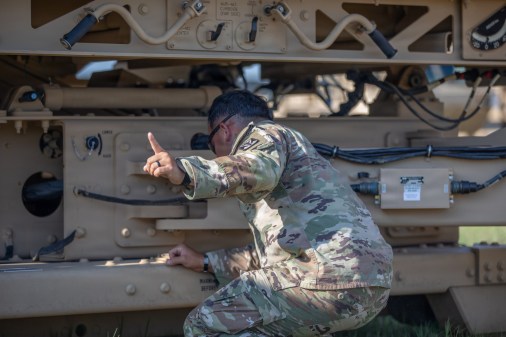
Expensive, clunky and unexpendable equipment poses risks to modern signal operators, according to officers. Systems requiring extensive tear-down time “is simply a liability and unrealistic” in an environment where targeting happens in as little as a few minutes, Ansell Jr. said.
During a recent test of the Army’s NGC2 prototype, soldiers reported displacing their command post nodes much faster than GWOT-era “TOC Mahals” offered, but even then disassembly could take 30 minutes.
Turner, who recently authored an article about tactical communications, said the Ukrainians lost more than 3,000 handheld radios and 300 Starlink terminals a month. They were adept at battlefield repair, he said, and used local vendors to make thermal covers for their Starlink terminals because they were emitting heat that exposed their positions, for example.
He compared that to the American military habit of calling field service representatives or sending equipment back to repair depots, which is “unsuitable” for a contested logistics environment, he said, adding the military had grown “too comfortable” with the practice.
“If a soldier can physically repair a radio but is blocked from configuring it because of a proprietary software key held by a commercial vendor, the system itself is a liability, unless we expect contractors to sit in the trenches with us, which I don’t think they want to,” Turner said. “We need them to unlock these black boxes that strip our soldiers of the life-saving ability to repair their own gear when they actually need it most.”
In parallel with its NGC2 efforts, the Army has begun to address with industry some of the connective tissue around this concern through its “Right to Integrate” initiative, though a law authorizing troops to outright repair military equipment does not yet exist. In May, the service had dozens of defense contractors, big and small, come to Fort Carson, Colorado, to get the Army’s vast, disparate stable military system to communicate with each other.
Modeled off Ukrainian efforts, Army leaders said at the time it had sent patches from “Operation Jailbreak” to the Middle East amid the Iran war. The Jailbreak effort has only continued to grow since then, officials said, and in the latest test of its NGC2 prototype, Army leaders banned vendors from entering Fort Irwin, California’s training area to wean off their support.
Observations of what’s been happening in Ukraine should further spur U.S. military efforts to adapt, the former SAG-U members suggested.
The basic concepts like emission control, having an upper hand in the decision space and situational awareness are certainly not new, they said. But the new ways in which they’ve been applied have already been tested.
“While there is no silver bullet to ensuring success,” Ansell Jr. said, “I believe we can learn these important lessons from our brothers and sisters in Ukraine, lest we have to learn them ourselves.”