‘Best of times, worst of times’ for the Coast Guard, commandant says, amid historic funding and legislative woes
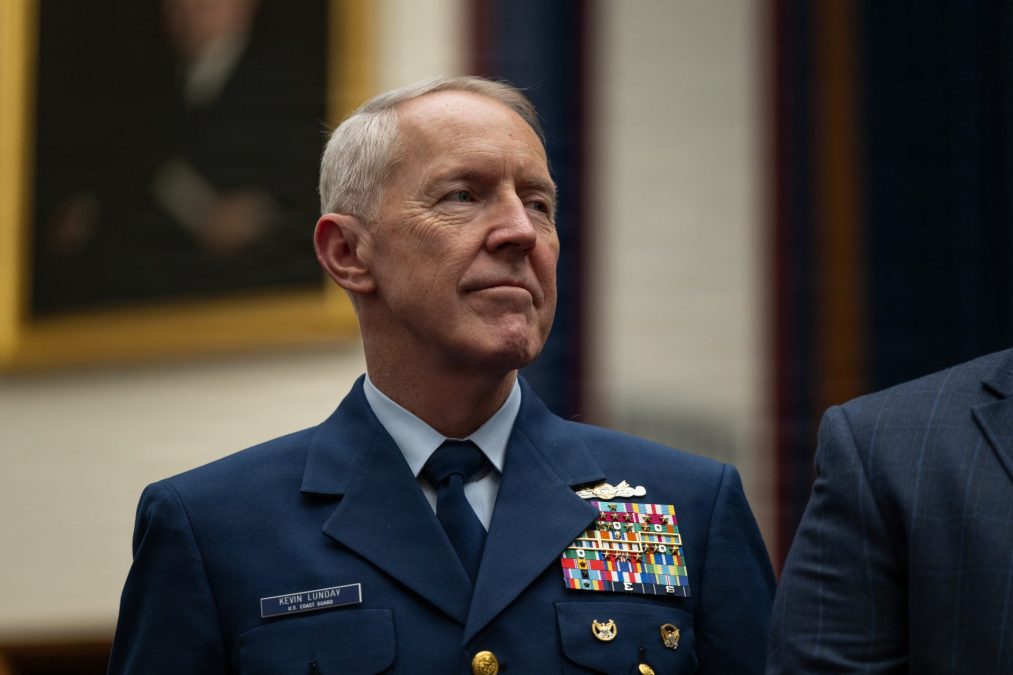
Invoking the immortal words of Victorian-era scribe Charles Dickens, the Coast Guard’s top uniformed leader said Wednesday “it was the best of times, it was the worst of times” for the service — a conflicting duality wrought by a lengthy legislative jam and unprecedented funding.
Fueled by $25 billion from the One Big Beautiful Bill Act last July, the single largest investment in the service’s history, the Coast Guard has “beg[u]n to emerge” from a “readiness crisis” that was decades in the making, commandant Adm. Kevin Lunday said at the Sea-Air-Space symposium.
Less than a year later, the service has already obligated more than one-third of that sum for new assets and plans to commit more than $22 billion by year’s end. Cutters, boats, aircraft, infrastructure and technology, such as unmanned tools in tandem with its nascent robotics rate, are teeming with cash amid the Coast Guard’s ambitious revamp known as Force Design 2028.
The fiscal 2027 budget request calls for billions and billions more for the service. But amid the spring of subsidized hope, there is a cold-snap of congressional despair.
For more than two months, the Department of Homeland Security — which the Coast Guard is a part of — has gone unfunded over lawmaker division on immigration enforcement, spurred by Democrats’ refusal to bankroll the agency after federal officers killed two civilians in Minnesota earlier this year.
POLITICO also reported Tuesday that Sen. Rick Scott, a Republican, placed a hold on hundreds of Coast Guard promotions over a shipbuilding dispute in Florida.
Last month, President Donald Trump ordered DHS to use emergency funds to pay employees, but officials have warned the money could dry up in May as Congress fights about the agency, including over enforcement reforms in the wake of the shootings.
According to retired commander and CEO of the Coast Guard Mutual Assistance relief society Brooke Millard, the service is facing utility shutoffs, refusal of fuel delivery, communications disruptions and parts delays amid the partial government shutdown.
“We heard the stories,” she told an audience at the Sea-Air-Space conference on Wednesday. “People on the verge of losing their homes, highly skilled mechanics unable to feed their families, and dedicated employees unable to put gas in their car to get to work.”
Lunday said “let’s get rid of the worst of the times and get back to great expectations” for the Coast Guard, referencing another Dickens novel that chronicles the trials of an orphan named Pip (who experiences wavering financial status throughout).
Meanwhile, cash from large, earlier funding that is allocated for tech or operations, for example, continues to flow.
The service has said $266 million of the OBBBA funding was going to long-range unmanned aircraft systems. The fiscal 2027 request constituted a “modest investment” of $110 million in the service’s aircraft stable, according to the Coast Guard, including for such far-reaching drones.
The Coast Guard has touted record-breaking drug hauls over the last year-plus, raking in billions worth of narcotics during operations in the Eastern Pacific and Caribbean amid Pentagon strikes in those regions that have killed more than 180 people the Trump administration alleges were trafficking contraband.
For the Coast Guard’s portion of curtailing drug smuggling, Lunday said, the service typically interdicts suspected vessels with a cutter that will launch an armed helicopter to disable the boat’s engine and then send a small team to detain passengers and seize drugs.
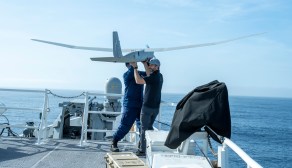
Ship-launched and short-range drones, as well as sensor technology and autonomous systems the commandant did not disclose, now make those interdictions faster. In one case, he said a Coast Guard team intercepted four vessels within about an hour.
“We’ve never done that before,” he said, though did not describe where and when the interdictions occurred. “In fact, we didn’t even think we’d be able to do it.”
He briefly mentioned the Coast Guard’s role in Operation Epic Fury — the name for U.S. military operations in the war against Iran, currently under brittle negotiations — noting that personnel and several Fast Response Cutters out of Bahrain were involved in the early days of the conflict.
Lunday said many new systems, including autonomous and AI-enabled platforms, center around the Coast Guard’s “primary weapon system,” otherwise known as a well-armed boarding team. DefenseScoop previously reported the service was looking for contractors to support drone employment.
The Coast Guard also plans to grow by 15,000 personnel by 2028 and recently announced the selection of a new training center that will be located in Alabama. Thousands of personnel are expected to be robotic mission specialists, a rating the service recently announced to boost its technological stable of experts, though so far there are none.
Lunday said the service has secured contracts to build 11 new Arctic Security Cutters for what he described as an increasing presence in the High North from Russia and China. The Coast Guard will need 1,300 people to crew and maintain those vessels, he said, an example of what the fiscal 2027 budget request intends to support.
Two of those cutters will be homeported in Alaska, where Lunday said several Chinese research vessels were spotted about 200 miles off The Last Frontier’s coast last year and the service used two ships to “chase them out of there.”
He called it an “unprecedented level of presence,” referring to the Chinese ships.
DefenseScoop recently reported about Marine EOD techs using subsea robots off Kodiak Island to hunt for ordnance as part of an exercise, in part, meant to project power in the Arctic.
Citing the utility of the fiscal 2027 budget request, specifically in reference to support of Coast Guard family members, Lunday said “first, we got to get out of this current lapse. That’s exactly what we need to have happen.”