Marine Corps will hold AI ‘hackathon’ to prototype tools for training, education
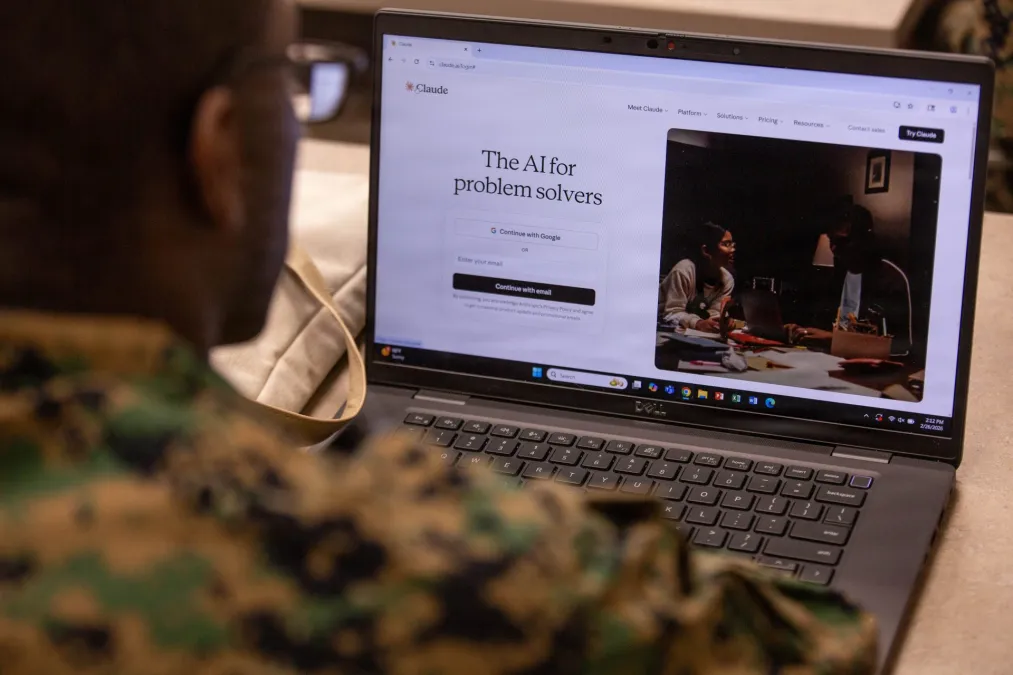
The Marine Corps will host a “hackathon” next month to develop AI tools for education, administration and training, the service said, an effort intended to test — and possibly scale — disruptive technology prototypes across the “defense education enterprise.”
The Marine Corps University and Naval Postgraduate School is inviting Marines, sister services, government civilians, vendors and academics to the “AI Learning Initiatives Hackathon” from Sept. 15-18 where teams will “develop functional software prototypes, accelerate data-enabled processes, improve learner outcomes, and build critical AI literacy,” the service said.
Other services have hosted “hackathons” in recent months, which are generally joint government-private sector events meant to test-out AI, machine learning, data or emerging technologies the Pentagon has been quickly applying to virtually every military function.
“Modern military training and education must adapt to the rapidly evolving character of war,” Marine officials wrote in an administrative message last week. “The integration of advanced technologies like AI/ML is a present warfighting and educational imperative.”
Last May, the Marine Corps released its AI implementation plan, a 56-page tome that outlined how the service would approach the disruptive technology over the next few years. Listing it as a top strategic goal, the service has hoped to formalize its training and education to build an “AI competent workforce.”
The service recently required Marines to complete a “Basic AI Course” before the end of the year and adopted the Pentagon’s commercial-backed large language model platform known as GenAI.mil, which wrought concern among some military personnel after its breakneck launch late last year.
In the civilian world, AI in education has become a hotly contested topic. Educators and students alike are increasingly using generative models in college classrooms, while battling concerns over plagiarism, diminished critical thinking skills and over-dependence.
The Marine Corps listed several “operationally relevant use cases” it hopes the hackathon will address, including but not limited to: personalized learning, simulation and virtual training, performance assessments, content generation for training scenarios and curricula, operational support — “just-in-time learning,” administrative functions and data analysis — and wargaming.
“Team entries will be judged based upon a predetermined rubric and set of criteria,” Capt. Colton Martine, a Marine Corps spokesperson, told DefenseScoop on Tuesday. “The criteria set will be supplied to hackathon participants when the hackathon portal launches in early September, prior to the event.”
Participants can apply to be “hackers” charged with developing prototype tools, whom the service prefers to have AI/ML, data science, data engineering or software development backgrounds. Attendees can also come as subject matter experts responsible for outlining use cases, “providing operational context” and guiding prototype development. Others can apply to support the event administratively or logistically, according to the message.
The deadline to apply is Aug. 14.
The event will be in-person, split between the MCU in Virginia and the NPS in California, officials wrote, though the first day will be conducted virtually from NPS. Over the course of the hackathon, participants will develop prototypes in teams for selected use cases and present them to judges for assessment. The best prototypes will receive a non-monetary award.
Martin said there are no rank requirements to participate in the hackathon and that judges will be a mix of military, government civilian and industry leadership, though he did not detail specific names or from which organizations they would come from.
On whether the Marine Corps intends to scale winning projects, Colton said “all submissions will be assessed based on the judging criteria and evaluated as part of an after-action report, which will inform the ability to be deployed, securely and at scale, to meet mission requirements timely and efficiently.”