Pentagon’s S&T boss touts early benefits of re-org, including ‘virtuous cycles of collaboration’
Marking a major move to overhaul the sprawling innovation ecosystem that underpins the U.S. military’s potentially eroding technological edge, the second Trump administration initiated a swift internal shakeup early this year that unified operational authorities and fragmented modernization work directly under the Defense Department’s Research and Engineering undersecretariat.
Specifics on organizational, personnel and financial changes associated with that realignment were sparse in the months that followed the Pentagon’s announcement — but new details are beginning to surface.
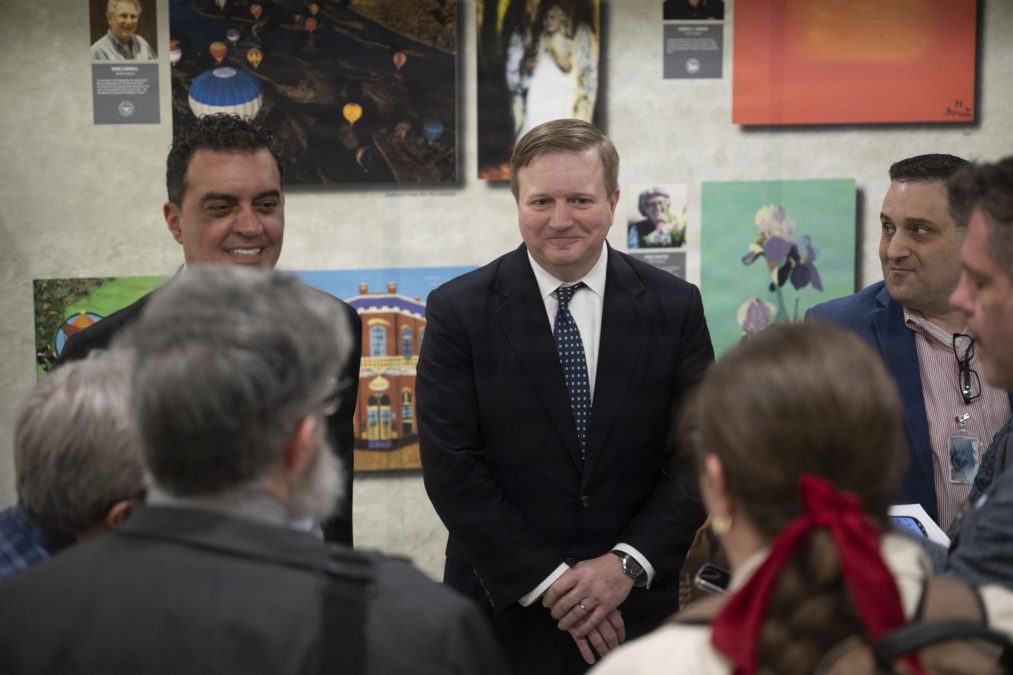
“We want to move fast,” Assistant Secretary of Defense for Science and Technology Joseph Jewell told DefenseScoop.
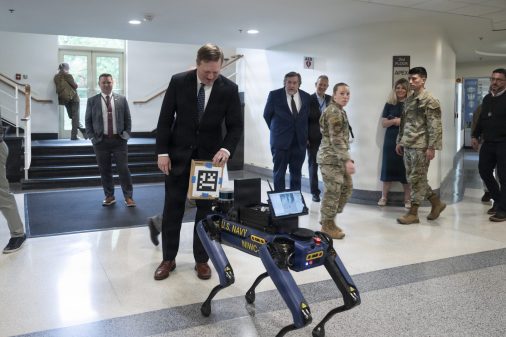
The senior official shed light on the department’s new R&E structure and near-term strategic S&T vision, during an interview on the sidelines of the Manufacturing Technology Exhibition at the Pentagon on Tuesday.
“I’m cognizant of the fact that my part of the portfolio is probably the most far-looking in temporal terms, right? Because we have to make [longer-term, future tech] investments,” Jewell said.
Before he entered the Senate-confirmed role in December 2025, Jewell was a professor of aeronautics and astronautics at Purdue University, where he served as director of two hypersonic wind tunnels, and a research scientist at the Air Force Research Laboratory — among other academic and defense research positions.
He’s now the DOD’s principal advisor on science, technology, developmental prototyping, and experimentation initiatives.
“I have three young sons — and I think about it — my oldest is 11. By the time he were to serve, if he wanted to, or either of his brothers, which I’d be thrilled if they did, I want to make sure that they have the best technology available in not just 2026, but in 2036, 2046, and going on,” Jewell noted. “So that said, we’ve got to deliver fast. And a big part of what this restructuring has enabled is these pieces of the organization to work more effectively together to do that.”
The DOD is the largest funder of federal research and development.
In January, Pentagon leaders unveiled plans to reshape the military’s research, development and innovation landscape — fusing various offices, activities and functions into one realm — under the leadership of DOD Chief Technology Officer and Under Secretary of Defense for R&E Emil Michael.
The shift was intended to reflect a sharper focus on speed and urgency, officials wrote in the original announcement.
Broadly, those instructions shifted the elements and functions of three assistant secretaries of defense under the CTO’s direction, and re-shuffled responsibilities associated with DOD’s modern technology priorities. Jewell said those teams might fall “within what you might call the core portfolio” for R&E.
“What we do in Science and Technology, specifically, is look at basic research and the first couple of levels of applied research,” he told DefenseScoop. “Then we also own the verticals, you might call them, in some categories. So we own two of the critical technology area verticals — those being hypersonics, of course, near and dear to my heart — and then also [biotechnology] and biomanufacturing. But then one of the other ones that we own, sort of the vertical, is in manufacturing technology, which is actually a huge part of the portfolio.”
The DOD’s recent overhaul also elevated and consolidated six DOD technology hubs — the Defense Innovation Unit (DIU), Strategic Capabilities Office (SCO), Defense Advanced Research Projects Agency (DARPA), Chief Digital and Artificial Intelligence Office (CDAO), Office of Strategic Capital (OSC) and Test Resource Management Center (TRMC) — as components within R&E.
Jewell noted that his S&T hypersonics team engages particularly closely, in a “powerful” way, with DARPA and SCO.
“We do a lot of work we can’t talk about with them, but we do a lot of work with them,” he told DefenseScoop. “And so, the new structure of R&E really sets up a lot of what you might call ‘virtuous cycles of collaboration.’ There are all these independent entities that are direct reports to [Michael], but then also the core portfolio, three assistant secretaries — and mine is the one that’s closest to the lab.”
Jewell’s office is also responsible for running the department’s Small Business Innovation Research (SBIR) and Small Business Technology Transfer (STTR) programs.
Notably, Congress recently reauthorized those programs through September 2031 — after a six-month lapse that started when the previous legislation expired last year. At the time, Jewell said his team was “ready to go.”
“Of course we had been anticipating and hoping for the reauthorization, but they had that thing live, I don’t know if it was in an hour — but it was certainly within a day. And so we did receive a lot of applications and they’re going through those. But we’re set to commit all of the funds rapidly and get that program back on track because that’s one that affected all 50 states and basically all areas of technology,” Jewell said. “Small businesses, in many cases, were not doing well.”
His team also steers and coordinates defense science and technical relations with a variety of the U.S. military’s foreign partners, including NATO and the Five Eyes alliance.
Jewell noted earlier this week at the Pentagon’s ManTech Awards that he’d “just returned from the Australian Defense Science, Technology, and Research Conference down under.” There, he said, allies expressed interest in partnering with the department “to rebuild and modernize their own manufacturing capabilities.”
Further, the S&T team that Jewell leads produces and manages the policies governing Federally Funded Research and Development Centers (FFRDCs) and University Affiliated Research Centers (UARCs), which conduct long-term studies and analysis for DOD.
The officials are also charged with overseeing the agency’s basic research programs and science, technology, engineering, and math opportunities.
“One of the things that I didn’t realize before taking over the job is that the department is the No. 1 sponsor for a number of K-12 and STEM activities,” Jewell told DefenseScoop. “So, for example, [my son recently participated in] the FIRST Lego League, and DOD is actually the biggest single sponsor for that.”