After back-to-back airspace blunders earlier this year, border task force shoots down ‘cartel-linked’ drones with AV laser
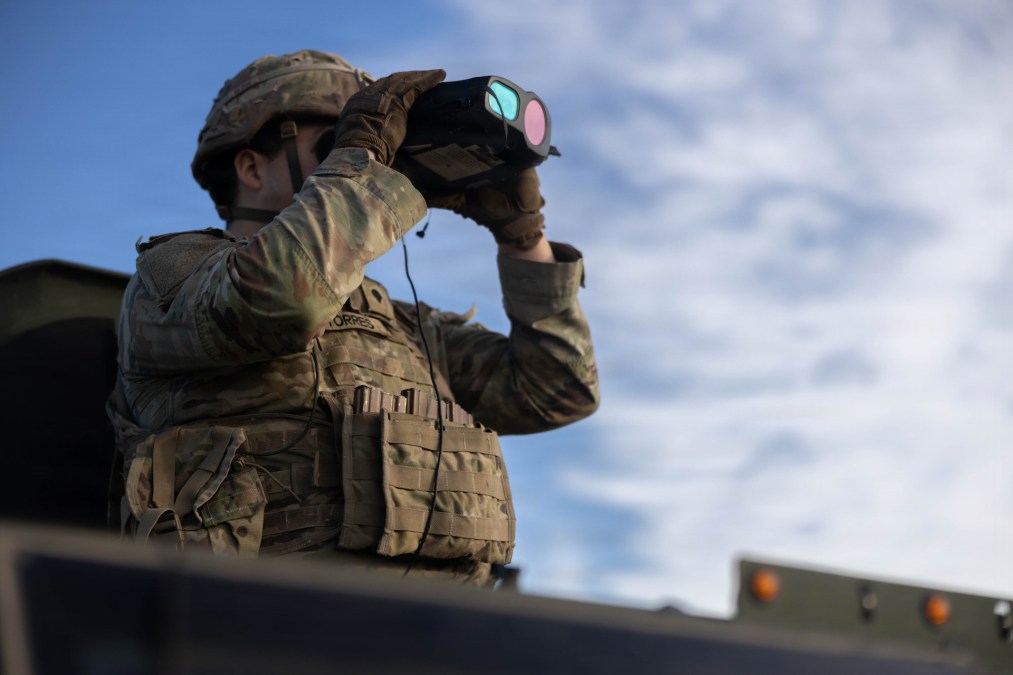
The military task force assigned to the U.S.-Mexico border zapped three “cartel-linked” drones using a high-energy laser developed by AeroVironment, according to industry and military officials.
Over two days this week, Joint Task Force-Southern Border used the Army Multipurpose High Energy Laser (AMP-HEL) system to “engage and defeat three hostile” unmanned aerial systems the unit determined were being used by cartels, according to a Thursday press release, citing the drones’ “use in direct support of activities posing a physical threat to” troops and border agents.
The announcement comes six months after the laser system was used in successive incidents, where U.S. Customs and Border Protection or service members separately employed the high-energy laser without adequately notifying each other or other agencies of their use of the new technology, causing temporary air space closures in Texas.
“Cartel networks are increasingly employing unmanned aircraft systems to facilitate illicit human-smuggling and actively spy on our personnel and law enforcement partners,” said Maj. Gen. Curtis Taylor, commander of JTF-SB, in the release. “By integrating layered countermeasures alongside advanced directed-energy capabilities like this laser system, we have made it clear that we will not tolerate hostile surveillance.”
The release did not specify exactly where the shootdowns took place or the model of the drones that were zapped.
A representative for AV, which develops the LOCUST family of high-energy laser systems, told DefenseScoop on Friday that it was the company’s system that was used in the most recent shootdown, but did not specify which model.
The military has been leaning into high-energy laser and high-powered microwave systems as less expensive and “non-kinetic” drone defeat options, especially as the Iran war illustrates the cost imbalance between using expensive U.S. interceptors against cheap drones.
The director for the Pentagon’s specialized counter-drone hub — Joint Interagency Task Force 401 — recently told DefenseScoop that the unit is running a directed energy pilot on several military bases to better explore their use.
“It’s a directed energy pilot — and so, when we say ‘directed energy,’ we say it to be inclusive of all novel technologies — but what we’re really focused on right now is high-energy lasers and then high-power microwaves,” Brig. Gen. Matt Ross, JIATF-401 director, said last week. “And we have a number of systems, and we’ve proven that the science works — like you can defeat a drone with both a high-energy laser and then with a high-power microwave — but we need to figure out how to use them successfully in an operational context.”
In February, CBP used a laser the Pentagon loaned the agency to zap an object near El Paso, DefenseScoop first reported at the time, which was later identified as Mylar balloons. Less than a month later, service members shot down a CBP-launched drone near Fort Hancock, Texas, after the agency didn’t notify JTF-SB of its plan to fly the UAS.
Those incidents caused the Federal Aviation Administration to temporarily close airspace above the areas and wrought bipartisan criticism from lawmakers, who said the agencies failed to coordinate the use of the experimental system.
In early March, the military tested the laser at White Sands Missile Range in New Mexico, DefenseScoop first detailed, largely to assuage concerns from the FAA about the system’s safety. The Pentagon and FAA signed an agreement the following month, declaring the system safe for use in national airspace.
JTF-SB said they were operating under U.S. Northern Command in support of CBP when it shot down the three drones this week. Multiple Northcom leaders have expressed concerns about the military’s ability to defend against drones domestically, and several military officials have dubbed the southern border as a testing ground for technology meant to help do so.
Late last month, JIATF-401 awarded CACI International a contract worth up to $500 million for its SkyValor system, another “non-kinetic” jammer tested on the border that the military hopes will add to its burgeoning suite of anti-drone systems.
U.S. officials have recently said that hundreds of drones fly near the border per day.
“We stand shoulder-to-shoulder with our CBP partners to secure this border, protect our service members, and disrupt these criminal organizations at every turn,” said Taylor, the JTF-SB commander.