Marine EOD techs team with robots in frigid Alaskan waters
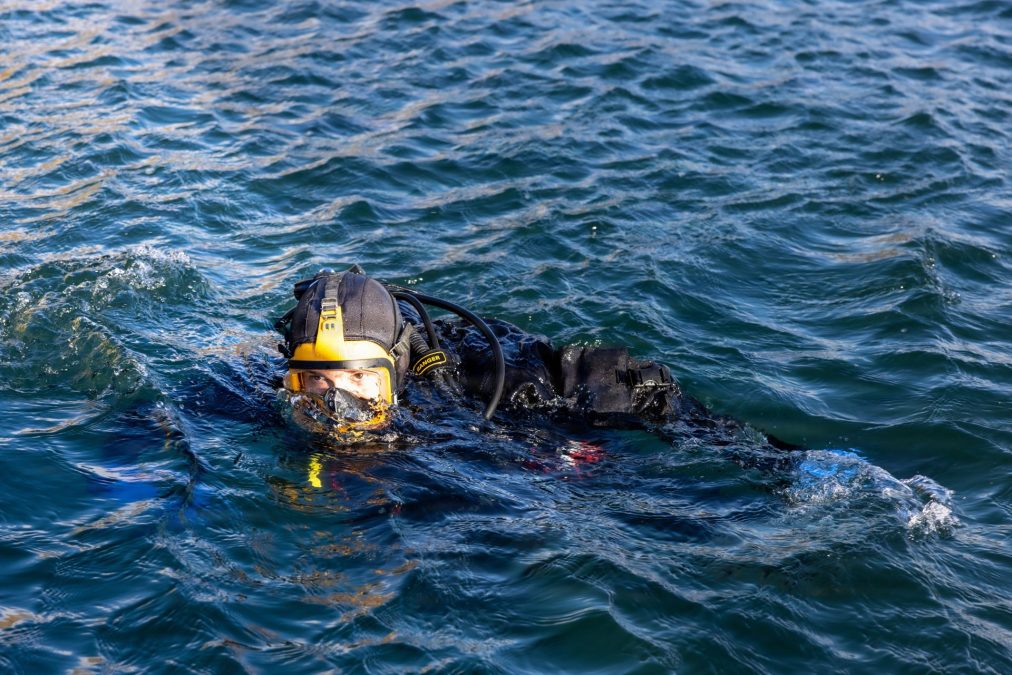
For Marine Chief Warrant Officer 2 Jonathan Veenhuizen and his dozen-man explosive ordnance disposal team, a day on Kodiak Island means prep dives into cold Alaskan waters — a far cry from the warmer kiss of San Diego waves they call home — and the launch of little robots to scour the surf for “anomalies.”
The Alaska exercise that he and his team participated in this month, known as Arctic Edge 2026, was the Marine Corps’ first time directly supporting subsea and seabed warfare under the tri-service maritime strategy, a service spokesperson said. It was part of an effort to bring the Marines, Navy and Coast Guard together for coastline operations, among other goals.
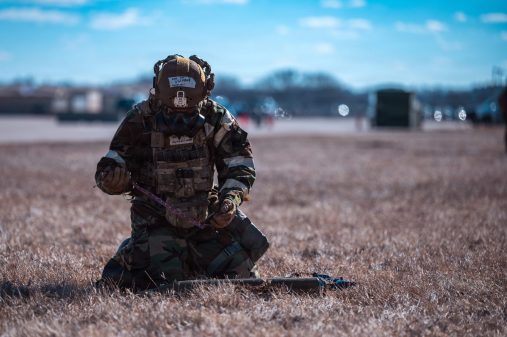
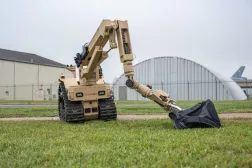
During the Global War on Terror, EOD techs operated on land, focusing on deadly improvised explosive devices in Iraq and Afghanistan for 20 years. The introduction of remotely operated vehicles added a layer of safety for these techs, as well as new trials they’re now working through as they look for bombs in the littoral zone.
“You enter a whole new realm underwater when you’re talking about explosives,” Veenhuizen said. Subsea pressure makes explosions more destructive to human bodies, invasive ocean salt crusts over equipment and then there are the frigid dives, for example.
“So anytime I can get an unmanned system, even though it may be expensive, it doesn’t come with a name and a family tied to it,” Veenhuizen, who is the officer in charge of Fox section out of 1st Marine Expeditionary Force, said. “I’ll put that in the water first.”
For several years, the Marine Corps has been exploring an ordnance disposal effort closer to the service’s historic, amphibious nature but nonetheless futuristic in its direction.
Arctic Edge incorporated a relatively new initiative called the Littoral Explosive Ordnance Neutralization (LEON) program, where techs like Veenhuizen pair underwater remotely operated vehicles (ROVs) with hard-earned EOD skills to prepare paths for forces near contested shores.
“The Marine Corps recognized back around 2022 that we needed an organic capability to be able to maneuver raid forces in and around archipelagos and our coastal waterways and other littoral locations,” Lt. Col. Andrew Cheatum, EOD lead for Marine Corps Forces Command, told DefenseScoop in a recent interview.
That realization became LEON, he said, which is complementary to the Navy’s mine countermeasures, but meant to be smaller and lighter with a focus on shallow waters to clear or avoid mines for incoming landing forces in combat.
The Marine EOD effort near Kodiak Island centered around supporting more than a dozen agencies in protecting critical infrastructure along Alaska’s coast, long thought of as vulnerable to Russian presence. Cheatum emphasized that the capability is meant to be global, able to operate from the Indo-Pacific to the Arctic.
“You have to think about the threats in the Arctic, short, medium term versus long term,” said Alexander Gray, a senior fellow with the Atlantic Council and former chief of staff of the White House National Security Council during President Donald Trump’s first term.
“Obviously, the short-term threat in the Arctic is very much Russia. Even in the midst of the Ukraine war, they’re putting substantial resources toward modernizing their legacy Arctic bases,” he said, noting joint Chinese and Russian “air and naval incursions” growing near the Last Frontier in recent years. “We have to treat Alaska as the very tip of our Arctic frontier.”
Part of the recent exercise was meant to “demonstrate capabilities” in the High North, and one of those capabilities put on display was with Veenhuizen’s team.
The EOD techs launched Autonomous Underwater Ground Vehicles (AUGVs) into the surf to prowl along the seabed. They dropped tethered Fusion ROVs designed by Strategic Robotic Systems, beetle-like submersibles with sonar, tiny propellers and a suite of bulbous cameras, which techs puttered through the surf to find anything out of the ordinary.
“Obviously the ocean, the seabed, is a massive, massive space and largely unknown,” Veenhuizen said. “It’s impossible to think you could dive and do manual searches with any kind of effectiveness in wide areas, so you need those systems covering wide swaths” to collect data.
These systems act as eyes and ears for the EOD techs, vacuuming up information from sonar readings to live video feeds. Eventually, divers may find themselves in the water should anything those systems discover require human hands to dispose of.
Their mission is part of a broader integration effort with the Navy, Cheatum said. Over the last several years and after the Marine Corps was used heavily as a land force during the GWOT, the two services (who have often been at odds over topics such as ship readiness) have tried to work more closely in the ocean domain, especially as U.S. officials have consistently warned of looming Chinese military power.
The idea, according to Cheatum, is to develop doctrine, bolster resourcing, train — and therefore learn — together. An effort “we hope will ultimately lead to a more credible naval force.”
“I think there is a concerted effort for the Marine Corps to look at ways that we can support naval objectives in all domains,” Cheatum said. “The Marine Corps will beat the drum about all-domain fires integration and all-domain reconnaissance and all types of other things. But in order to actually truly provide that all-domain capability, you cannot ignore the undersea and littoral areas.”
Robotic systems are becoming a massive part of that effort, and both services have been investing heavily in the capabilities.
Veenhuizen said that he started working with these systems about three years ago. Before then, they were “just on the periphery” of his now 17-year Marine Corps career. While he recognized the utility of these systems, both as reconnaissance assets and risk mitigators for his team, they bring some downsides.
Salt water “can be a nightmare in all equipment,” and while battery technology has improved immensely over the last several years, “tending” them, as Veenhuizen puts it, means they need to be closely monitored and swapped for long-duration missions common to the EOD world.
EOD techs have had to take on the additional task of developing expertise with new (often expensive) robotic platforms, all while juggling their existing responsibilities.
The pipeline for EOD techs is already extensive, Veenhuizen said, and “we’ve asked them to now become experts on these extremely advanced systems, not to mention all the diving, not to mention their general EOD knowledge and [unexploded ordnance] and [familiarization with] other peer and adversary ordnance types.”
“It’s a lot of information crammed into these guys, and I got 12 of them in one section” who have additional responsibilities, he added. Because LEON is new, he said, more and more agencies have wanted to work with them to see how the capability fits into their own efforts.
“We’re asking a lot out of these Marines and that’s something that, if anything I could highlight, those guys are a special bunch that [are] able to do all these different mission sets,” he said, noting that they are masters of their trade. “These guys are still stretched out and they’re achieving that mission every day.”
Cheatum pointed to the use of early ground robotics during the GWOT as evidence for institutional Marine Corps familiarity with such systems, ones that have been in the service’s arsenal for years. Cheatum acknowledged the challenges the “different class” of undersea robots may bring, but said the Corps was aware of them and prepared to address them.
Despite the challenges with adopting brand new systems, Veenhuizen said “we are modernizing and it is for the better.”
“We are moving towards a true 21st-century capability in a lot of ways, even at this small, small, bottom-level tactical unit, this chief warrant officer and his 12 Marines are moving forward in a way that I wouldn’t have dreamed of the first time I went to Afghanistan,” he said. “I would not have been thinking anything like this — to be where we’re at 15 years later is insane.”
Updated on March 24, 2026, at 12:20 PM: A previous version of this story misspelled Andrew Cheatum’s last name. This story has been updated to reflect the correct spelling.