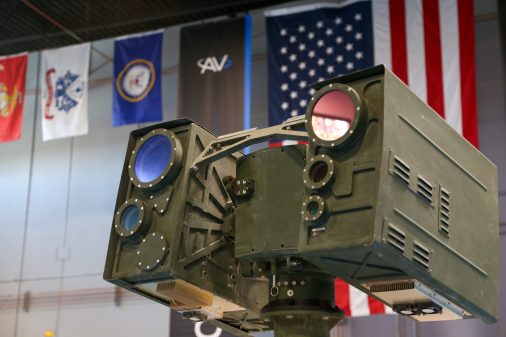
Pentagon awards deals for laser weapons that could shoot down drone swarms

The Defense Department has awarded other transaction agreements to nLIGHT Defense and Lockheed Martin Aculight for directed energy weapons as the military seeks new tools for zapping adversary drone swarms and cruise missiles, the Pentagon announced Thursday.
The deals, valued at $86 million, will support the Joint Laser Weapon System program, spearheaded by the Pentagon’s Research and Engineering directorate.
Defense officials have long-touted the benefits of DE systems such as their high-speed engagement, low cost-per-shot and deep magazines. However, despite their promise, the Pentagon has historically struggled to transition such platforms from research and development to larger-scale production and fielding.
Scaled directed energy (SCADE) is one of six Critical Technology Areas that the R&E undersecretariat is working to advance under Pentagon CTO Emil Michael, as the military looks to push into production more cost-effective means of thwarting drone swarms and other threats.
“We must actively defend the homeland against emerging threats,” Michael said in a statement Thursday. “We are partnering with industry to rapidly deliver deep magazine directed energy capabilities to the Joint Force that can be seamlessly deployed across multiple domains.”
U.S. military officials have been banging the drum about the need to counter the growing threat posed by attack drones and other unmanned aerial systems, which have proliferated and been widely employed on battlefields in places like Ukraine and the Middle East. The Pentagon is also moving to better protect military installations and other sites in the homeland from small drones.
To address “urgent operational demands,” the initial Joint Laser Weapon System prototypes will provide approximately 150 kilowatts of power, according to a press release. But the department plans to boost those capabilities.
“Subsequent iterations will be scaled to reach the 300–500 kW threshold required for robust cruise missile defense. Additionally, by leveraging a laser source developed under the [R&E directorate’s] High Energy Laser Scaling Initiative (HELSI), a 500-kW integrated system will concurrently be developed. Utilizing containerized form factors, the systems will be designed for modular integration across both ground and naval platforms, enabling rapid fielding across various geographic combatant commands,” officials wrote in the press release.
According to fiscal 2027 budget documents, the JLWS program aims to “build, deliver, and demonstrate an operationally relevant capability in a platform-neutral package while also buying down non-recurring engineering costs for Service acquisition.”
The services have also been working on directed energy projects, such as the Army Multi-Purpose High Energy Laser that was tested in New Mexico earlier this year.
Military officials have said DE platforms are expected to complement kinetic systems like interceptors, not replace them, and give commanders more options for defending against drones and missiles.
The department wants to integrate DE weapons with kinetic and other non-kinetic tools as part of a “multi-tiered defense framework that provides flexible options to the warfighter,” per the budget documents.
The new deals announced Thursday fall under an initiative with a total program ceiling of $847 million, according to a Pentagon press release.