Pentagon eyes ‘more and more bunkers’ and other tech to shield troops in Operation Epic Fury
Iran’s weapons launches and arms cache continue to diminish as Operation Epic Fury enters its second month, according to Pentagon leaders who supplied updates on the large-scale military campaign that involves at least 50,000 U.S. troops so far.
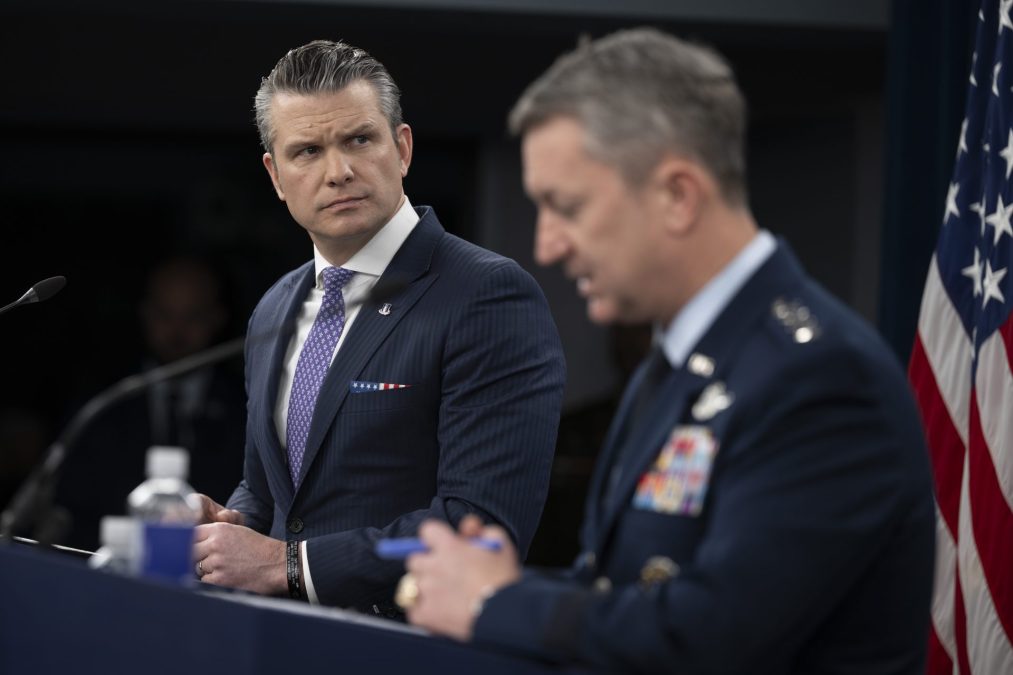
Secretary of Defense Pete Hegseth and Chairman of the Joint Chiefs of Staff Gen. Dan Caine said forces continue to focus on the fortification of installations, assets and personnel with a mix of air-and-missile defense capabilities, including electronic warfare options, amid this U.S.-led, Israel-coordinated operation against Iran.
“If all of our people are in one place, you can imagine why that’s a big problem. So dispersing is part of that defeat. Alongside that disbursement is more and more bunkers, and I can tell you — talking to base commanders, talking to our allies in Israel, talking to others — rapidly fielding that and then improving those positions is a theater priority, as are the air defenses and the layered air defenses,” Hegseth said Tuesday. “It’s not just Patriots and THAAD missiles. It’s fighters and defensive [combat air patrols]. It’s other kinetic defeat systems. It’s electronic warfare. So, the defense of our troops and our assets is maxed.”
The defense secretary revealed he went on a secret, previously undisclosed trip to the Middle East this weekend, where he met for about half-a-day with U.S. military pilots, intelligence analysts, and missile defense personnel deployed in Epic Fury.
President Donald Trump launched the operation on Feb. 28. Since then, he and his top advisors have reiterated that the broad aim is to destroy Iran’s leadership, ballistic missile and drone capabilities, naval power, manufacturing capacity and nuclear infrastructure.
In response, Iran is holding up maritime traffic on a major global shipping route for oil near the Strait of Hormuz, and attacking U.S. military facilities and other targets with deadly drone and missile barrages around the Middle East.
U.S. Central Command’s spokesperson, Navy Capt. Tim Hawkins, told DefenseScoop that 348 U.S. military personnel have been wounded in this war as of Tuesday.
Of those injured troops, Hawkins said 315 — or about 91% — have returned to duty, while 6 remain seriously wounded.
Those stats have shifted since March 24, when Hawkins reported that 290 American service members had been wounded, with 10 seriously wounded and 255 back on duty at that time.
At least 13 U.S. troops have been killed during the conflict.
“The upcoming days will be decisive. Iran knows that, and there’s almost nothing they can militarily do about it. Yes, they will still shoot some missiles, but we will shoot them down. Of note, the last 24 hours saw the lowest number of enemy missiles and drones fired by Iran,” Hegseth said at the Pentagon. “They will go underground, but we will find them. We recently destroyed another one of their command bunkers.”
In his remarks, Caine said that the U.S. “struck more than 11,000 targets” over the first 30 days of Epic Fury.
Forces are now moving to deliver precision strikes against Iran’s key manufacturing nodes, component storage sites, and research facilities deep within its territory. They also remain focused on eliminating Iranian mine-laying capabilities and naval assets.
“Just last night, we had 200 dynamic strikes alone. A dynamic strike is a strike where a pilot leaves and during their flight, they get a new target set based on real-time intel given to them — a new launcher, a new location, a new troop formation,” Hegseth said. “A dynamic target is one that changes while you’re in the air because of improved intelligence. So, 200 dynamic strikes alone, in addition to the pre-planned targets.”
The secretary stressed that the U.S. will continue to prioritize unpredictability in Epic Fury by keeping all options open, including the deployment of ground troops in the near term.
Meanwhile, lawmakers and analysts are raising concerns about the conflict rapidly depleting America’s munitions arsenal, particularly by consuming high-end air defense interceptors, precision-guided missiles, and stressing naval resources in the region, as well as its legality.
Hegseth did not comment on how the ongoing operation is impacting the nation’s warfighting assets, beyond mentioning that during his visit with U.S. forces in the Middle East Saturday a junior airman told him that her team wanted more, and bigger, bombs.