Coast Guard wants contractors to provide and operate drone services from cutters, shore-based sites
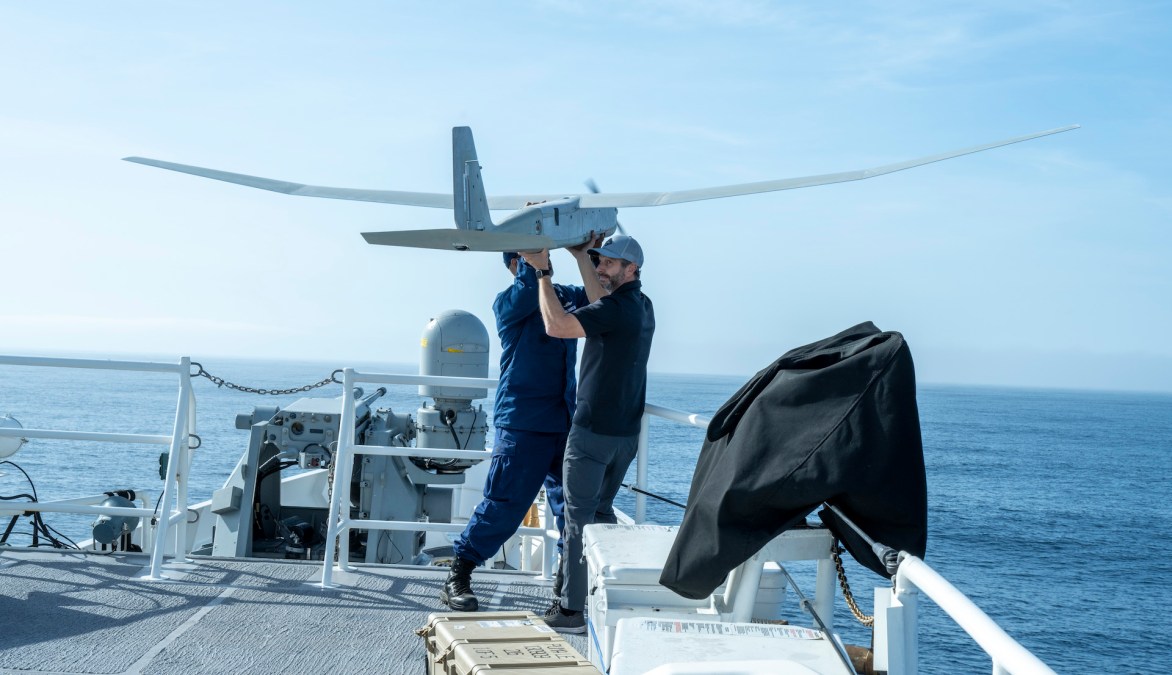
Coast Guard officials are trying to identify contractors that can provide drone equipment and services to support intelligence, surveillance and reconnaissance operations.
The effort is being led by the Robotics and Autonomous Systems Program Executive Office that was established last year to support the organization’s modernization efforts laid out in Force Design 2028.
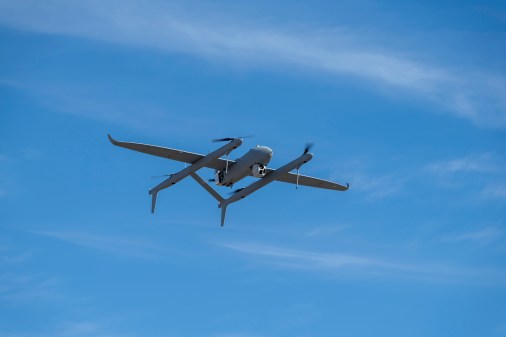
Specifically, officials are interested in medium-range unmanned aerial systems that fall under the Group 2 and Group 3 UAS categories to carry sensors and launch from a variety of Coast Guard vessels and installations ashore, according to a request for information released Wednesday.
The Coast Guard is considered a military service but also performs law enforcement functions under the Department of Homeland Security.
The contractor-owned, contractor-operated (COCO) drones and services “will be in direct support of ISR missions requiring persistent imagery with various types of sensors,” per the RFI.
“Contractors shall be capable of providing ISR services on a normal and surge basis, day and night, 24 hours a day, seven days a week. Pre-deployment, deployment, and post-deployment support will be required, and entail execution of a variety of responsibilities inherent to execution of such support, including but not limited to equipment transportation, export control licensing, insurance, personnel travel, visa coordination, and regulatory compliance,” the contracting document states.
The technologies and services would be intended to help with the surveillance, detection, classification and identification of maritime “targets of interest” including small, low-profile vessels like go-fast boats and self-propelled semi-submersibles used by drug traffickers, contraband, and people in the water who need to be rescued.
Systems should be able to transmit sensor data and imagery to Coast Guard cutters, boats and aircraft via a compatible remote video terminal. They may also be tasked to provide “target illumination” and act as a communications relay between Coast Guard assets and entities of interest, officials noted in the RFI.
Under the COCO arrangement, contractors would be responsible for the delivery of non-developmental drone equipment, production of sensor data, trained personnel, certifications, operation and maintenance, spare assets, and deployed mission support.
Operating locations could include up to a total of 35 shore-based sites in the Atlantic, Pacific, Alaska and Arctic regions, as well as national security cutters, offshore patrol cutters, medium endurance cutters, icebreakers and arctic security cutters, according to the RFI.
Performance specifications for a variety of anticipated platforms were included in attachments to the RFI.
Industry responses are due May 8.
Officials plan to procure these types of services via orders issued against a basic ordering agreement with one five-year base ordering period plus one five-year option period, per the RFI.
The Coast Guard isn’t the only sea service interested in COCO drone services. Last year, the Navy announced plans to give several companies the opportunity to compete for delivery orders.