Hiding in the spectrum: Inside the Army’s race to make the command post disappear
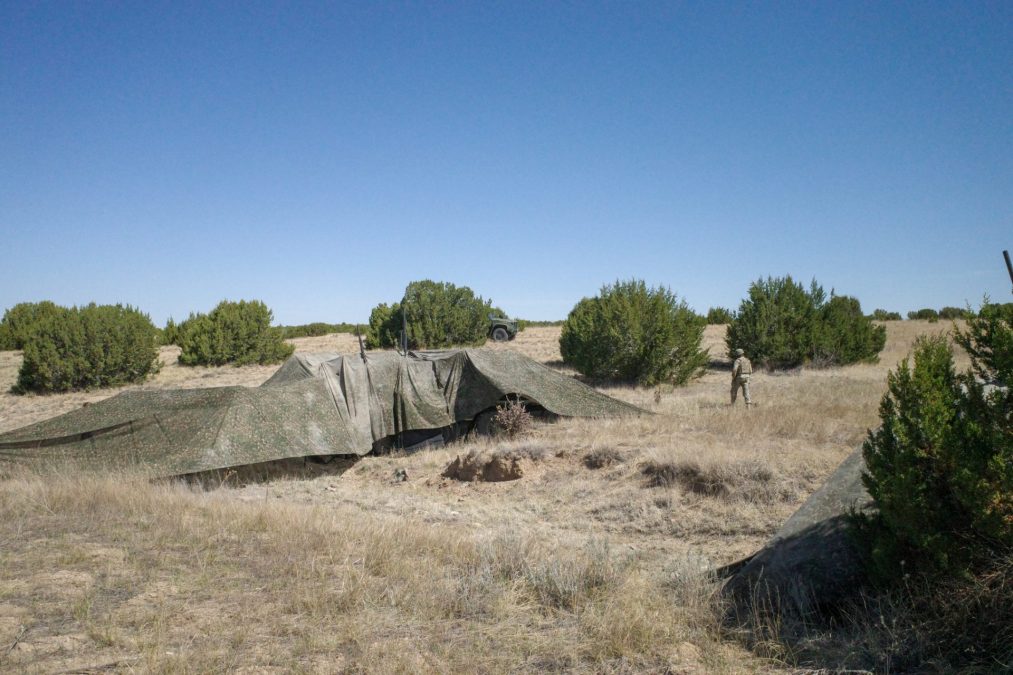
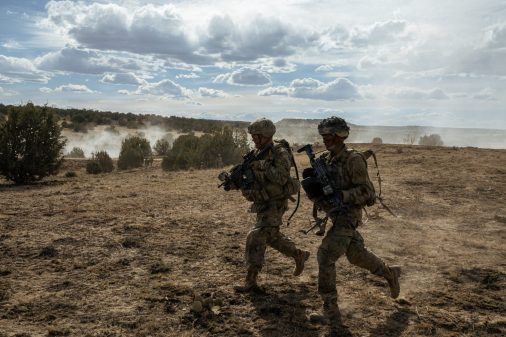
PIÑON CANYON, Colo. — It was hard for the naked eye to tell the difference between the Strykers, shrouded by deep-green camo nets, and the clusters of one-seed Junipers that turned dark emerald when dusk threw shadows across the high plains of southeastern Colorado.
The eight-wheeled troop carriers, soldiers and trees alike cast dark, irregular shapes for miles, though they often cloistered in dusty draws or behind gold-grass hills that cut across all quarter million acres of the Piñon Canyon Maneuver Site.
But the 4th Infantry Division soldiers here have become less concerned about what the naked eye can see and more troubled by the new war chest of sensors, optics, drones and electromagnetic gadgets attempting to detect them, their equipment and the unit’s critical command and control network, dusk or not.
For this technology, there is perhaps no more tantalizing sight than a command post: a physical encampment composed of troops, staff officers, leaders, vehicles, generators, communications equipment and systems. They are planning and operations hubs by which commanders synchronize and project their forces against the enemy.
Maj. Gen. Patrick Ellis is one of those commanders. On a hot, dry afternoon in mid-May, the top officer of 4th ID sat in the back of his Stryker and explained how the division was changing to hide its C2 apparatus from this watchful technology, and therefore from the waves of novel weaponry that could target his most crucial formations.
“Once upon a time, several years ago, large satellite dishes, large transmissions, different types of frequencies made us very, very susceptible to [the enemy] saying ‘Oh, I know exactly what that is,’” Ellis said.
During the Global War on Terror, the Army established large, static and complicated command posts, which became fixtures of rotational units flowing through the service’s training centers. Soldiers cheekily called their components “TOC Mahals.” In the new age of war wrought by the Russia-Ukraine conflict, these CPs and their tactical operations centers would not survive.
They had massive tents, crammed with planners and leaders near clusters of antennas and dishes reaching for the sky. Army officials wrote in a doctrine note earlier this year that should the service employ these types of C2 sites against a modern adversary, it would be “suicidal.”
“The issue now is that we’re going against an adversary that is significantly more capable than the adversaries that we were fighting in Iraq and Afghanistan, and part of their capability is the ability to detect command posts and other things across the operating environment very aggressively” through remote sensing, EW and drones, said Justin Lynch, senior director at the Special Competitive Studies Project, who recently authored an article about Army CPs.
“So you can almost bet on a high probability of something that has a notable command post signature being detected,” he added.
Over several days last month, DefenseScoop spent time with the soldiers of 4th ID during Ivy Mass, the latest exercise in a series of trials for the Army’s nascent Next Generation Command and Control program. The initiative is a top priority for the service, and aims to give commanders a unified suite of data-synced military systems so they can make faster, better and more informed decisions against increasingly sophisticated adversaries. 4th ID is currently one of two divisions across the Army that has become a de facto testbed for the program.
Much ink has been spilled over NGC2’s ecosystem of interconnected hardware — such as radios, tablets and terminals, soldier-facing applications that wield large language models to streamline intelligence or artillery processes, and the data repositories that underwrite real-time operating pictures for American commanders. Electromagnetic and cyber warfare itself has received ample attention throughout the war between Russia and Ukraine.
But DefenseScoop also observed an emerging, parallel change the Army had sought for more than a decade but struggled to actualize, and it centered around the physical architecture of these “command post nodes.” Some were smaller and more mobile than their predecessors. Planners accustomed to face-to-face meetings were now video or text messaging across miles of austere terrain, their comms pinging around a closed network of analogous nodes.
Not every sub-unit had access to the capabilities these nodes promised, and DefenseScoop did not observe any counter-drone capabilities with the sites it visited. Lynch argued that dispersion and mobility techniques alone could not withstand the volume of drone and electronic effects ramping up in Eastern Europe. The division was testing deliberate trade-offs between security, speed, sustainment and synchronization to bring this new way of C2 to bear for the Army.
But for now, the general’s Stryker, its original design more than two decades old, carried signs of how the old GWOT ways were changing and what was to come.
Bench seats were moved to accommodate large, commercial-looking screens that displayed several new combat widgets and options to attend meetings 1,500 miles away in Washington, D.C. There were no crackling VHF-FM radios to be heard, though a Starlink terminal perched above the general could connect him to the internet via satellite. The vehicle could run about a quarter mile of fiber optic cable into a hard site if he wanted it to.
The Stryker was part of a Mobile Command Group, a mini-HQ intended to keep Ellis connected with his entire formation, even — and especially — on the move.
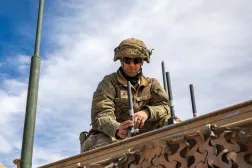
He could cycle between different network types, lurking amid the noise of whichever emissions were most common in the rest of the local electromagnetic spectrum. The soldiers called it “hiding in the spectrum.” His division-level MCP wouldn’t look much different on a heat map than any other unit on the battlefield, according to Ellis and other soldiers, making it harder for an adversary to determine which signature was more or less important to strike, if they could find it.
Warrant Officer 1 Jacob Wiley, an EW tech with the division, said that soldiers were facing “real jamming” during the exercise, forcing company-level units to work through tactics, techniques and procedures while leaders emphasized the real-world risks of personal signature emissions.
“I think it’s a lot harder now,” Ellis said of an enemy’s ability to detect his C2 nodes. “You’re not looking for a needle in a haystack anymore. You’re looking for a needle in a stack of needles.”
Dispersed and mobile. Is it enough?
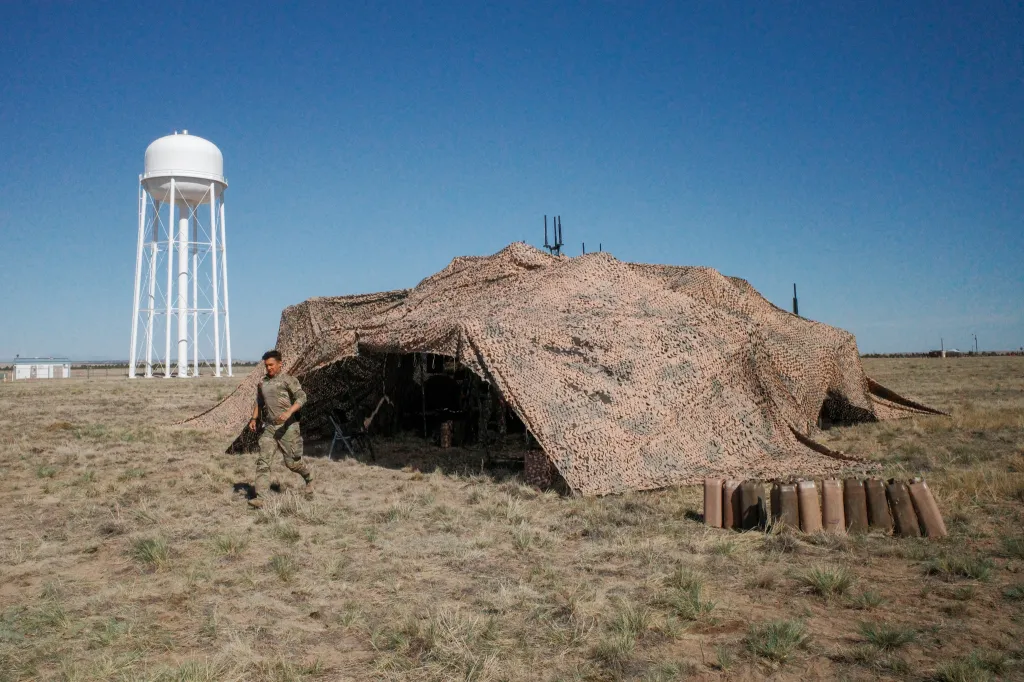
Maj. Dave Hickox stood in front of his node, a tan bulb that looked squat compared to the white water tower a few hundred feet away. Both were visible across the high plain. Jerry cans were lined up near the entrance of the camo net, which was humming with the sound of a generator. Inside, a group of soldiers passed validated targets to the Joint Air-Ground Integration Center, the “killing machine” of the division.
“If you were to tell me about eight months ago that I would be by myself, not in visual contact with my complementary JAGIC component,” Hickox said, pausing to gesture toward where he thought (but didn’t exactly know) the JAGIC was, “I probably would have a heart attack.”
The nodes across Piñon Canyon were widely dispersed, and included officers like Hickox responsible for critical functions like logistics and battle planning. In the TOC Mahal days, staff officers would have been physically grouped together.
But these are not the TOC Mahal days anymore. Not only are the nodes spread out to prevent consolidated targeting by an enemy, they form a “redundant” communications network. So if one is hit and destroyed, the rest just ping off a different node like a regenerative membrane.
The result is a disparate field of planners helping run the war through voice calls, text-based messaging and virtual, collaborative capabilities that one staff officer described as having “John Madden-like functions” to sketch out battle plans with other soldiers miles away. The traditional CP is a bit of a misnomer at 4th ID. Here, the whole battlefield could be considered one.
Before, Hickox would “need to get in there in person, sit down next to people, be able to talk,” he said. “But now, with our chat architecture and everything else, it doesn’t make a difference. I could be on the road, I could be stationary here with nobody else in our vicinity.”
He, like other troops DefenseScoop spoke to, said the set-up and tear-down of the node was faster. In his case, it took about 30 minutes. Another officer, Lt. Col. Tim Chess, said that his node consumes “significantly less power” and the Army’s new lightweight, hybrid Infantry Squad Vehicle-Heavy can drive up to his mobile trailer and help charge it.
The Army doctrine note listed mobility, along with size, positioning, hardening, signature management and redundancy as characteristics of a modern, survivable CP node. Other units, such as the 3rd Mobile Brigade Combat Team out of Fort Campbell, also applied these concepts in a recent training exercise, according to its commander.
In Piñon Canyon, a decidedly vast, non-urban environment with few hardened sites, troops frequently offered the mobility of their vehicles — and the ability to keep connected while driving — as a key survivability mechanism.
“We don’t have to pause and halt,” Hickox said. “We’re going to move at breakneck speed to get to wherever we need to go, and while we’re there, we’re going to develop a plan on the move, we’re going to get a collection strategy together on the move, we’re going to continue to target all through just setting our automations up.”
Leaders were also working through how best to balance the other characteristics, asking themselves questions about when to hide in the noise or stick out to prioritize data flow, how to protect themselves while moving and where to tuck in across the dry expanse.
Recent developments in the Russia-Ukraine war especially highlight a risk to mobility reliance, and even the smaller signatures, where Kyiv’s forces are projecting a large volume of drones across vast distances that can strike moving vehicles, Lynch said. Earlier this week, an Army intelligence official laid out what targets of all kinds are facing in the war, pointing to a recent Russian attack that used 70 missiles and more than 600 long-range drones in a single volley to emphasize just how saturated modern conflict has become.
Ukraine has “overcome a lot of the technical challenges there, [and] we should expect that adversaries will be able to replicate that capability moving forward,” he said. Pulling it back to Ivy Mass, “if they’re training against an adversary or fighting an adversary that can put a high density number of drones overhead that go from detection to targeting and actually striking in a matter of seconds, the ability to move quickly or displace in 30 minutes isn’t all that helpful.”
Lynch said that some of the “best successes” for CP survivability have come from dispersing across urban terrain, hiding within the background noise of both electronic and physical signatures and then “actually going underground,” something the American military medical community has been experimenting with to help protect its wounded from drones.
“It’s going to require a significant amount of investment by the U.S. military, but it’s something that’s worth doing,” Lynch said. Ellis noted that some units did occupy buildings at the maneuver site for protection. They are known as Military Operations in Urban Terrain (MOUT) sites, and were painted with symbols evocative of the countries the U.S. fought in during the GWOT.
While the simulated opposition force used drones against the 4th ID soldiers, it was unclear how many of them the “red team” deployed. Over two days, DefenseScoop observed one drone. Of the roughly dozen nodes and units the publication visited, no troops reported having organic counter-drone capabilities — an ongoing challenge for the military to scale overall.
EW techs said that to be more effective, they’d want more equipment, soldiers and spectrum analyzers to see friendly signatures so they could better ascertain what the enemy could detect.
“Right now, we’re heavily relying on our teams, so locally I can’t do a spectrum analysis — we just don’t have it fielded,” Wiley, the EW tech, said. “My teams are forward … I should be fine,” he thought, “but really, I need to be able to assess my own location and support them from wherever we’re at.”
Next month, 4th ID will go to the National Training Center at Fort Irwin, California, for Project Convergence Capstone 6 in a highly anticipated test of NGC2 and the new way the division is attempting to reconfigure three decades of GWOT practices that won’t work during large-scale combat operations.
“I think we see the trade-off in all of this,” Ellis, the commander, said from the back of his Stryker baking in the mid-May sun. “I think the better we can understand what those trade-offs are, the better we’ll be able to employ the capabilities we’ve been given.”
“But the fact of the matter is this division a year ago fought in three large command post nodes, largely because that’s where the satellite dishes were,” he added. “Because we got rid of that requirement, we no longer have to collate around these satellite dishes. We can now command and control from everywhere. I think the sky’s the limit. I think we’re just learning how far we can actually disaggregate this.”