- Sponsored
- Insights
Defense industry shifts procurement model to speed drone deployment
Few technology developments have turned the military’s acquisition and deployment requirements upside down more than the advent of cheap drones.
Defense officials have made major strides in deploying unmanned air and sea craft over the past decade. The rescue of downed helicopter pilots in the Strait of Hormuz by an autonomous Corsair maritime vessel earlier this month illustrated how years of investment appear to be paying off.
But the surprising success — and rapid evolution — of inexpensive autonomous systems and drone technologies in Ukraine and the war with Iran have made it clear that traditional five-to-ten-year hardware procurement cycles and high-priced systems no longer meet the needs of modern warfare. That’s prompting the military services and the defense industry to fundamentally restructure their acquisition models.
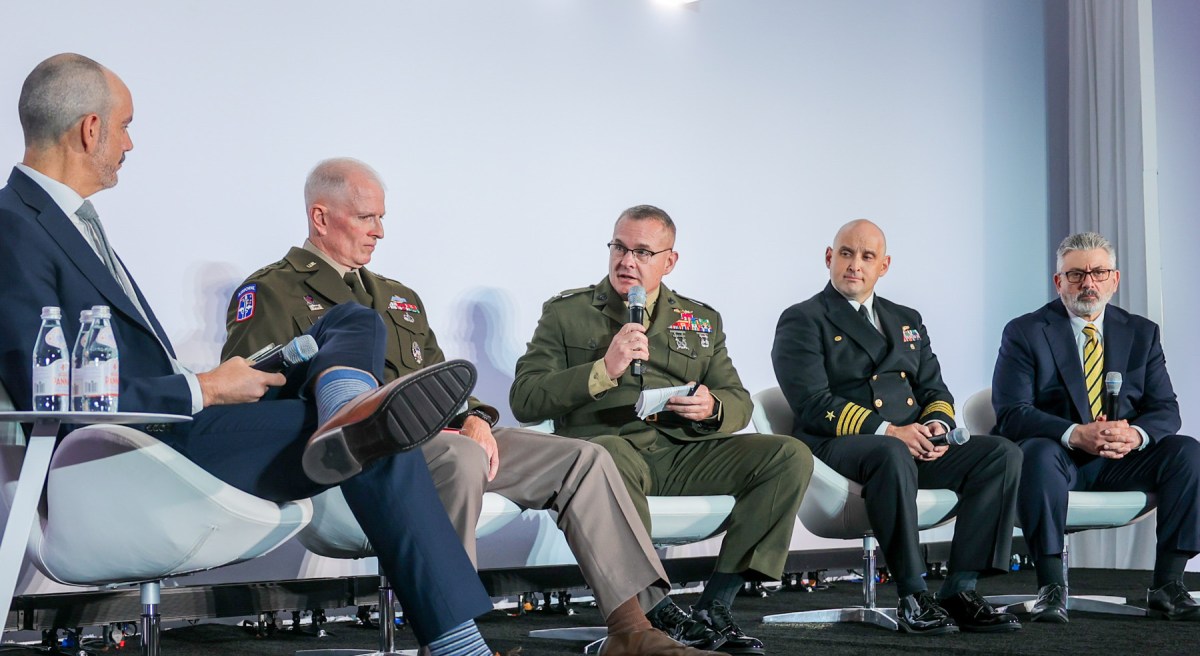
Part of that restructuring involves shifting how requirements are established by encouraging engineers to test new technology solutions directly on the battlefield, according to defense and industry officials who spoke at the recent GDIT Battlespace of the Future summit, hosted by Scoop News Group.
Rather than evaluating unmanned autonomous vehicles (UAVs) solely on standalone hardware specs or volume, defense agencies are also prioritizing the development of operating systems that more easily integrate with common command-and-control networks.
“To me, it really comes down to two things… The first is adaptation… The second is integration and common control,” said Brig. Gen. Anthony Gibbs, Capability Portfolio Executive for Mission Autonomy for the U.S. Army. To that end, Gibbs reinforced the need for standard procurement methods that align with the threat envelope.
Flipping procurement paths in active commands
As part of efforts to accelerate acquisition and deployment, the military branches are actively upending traditional requirements-generation by executing acquisitions in reverse.
Rather than starting with a set of requirements and shopping for the most qualified solutions, defense leaders are having programmers identify a specific field operational problem and prototype technical components directly alongside operational units. The parallel approach allows teams to update tactics, techniques, and procedures (TTPs) and justify production funding while the core technology is actively field-tested.
“The acquisition reform we’ve been through over the last year and a half fundamentally gives us tools we did not have before,” said Captain JJ Murawski, Chief of Staff for Portfolio Acquisition Executive Robotic and Autonomous Systems for the Department of the Navy. The new flexibility allows acquisition executives to “change the way we do requirements” and adjust dynamically to emerging maritime threats. It also enables engineers to bypass the lengthy five-year planning cycles that routinely stall innovation, he explained.
In a similar vein, the Army’s “Transforming-in-Contact” modernization initiative is helping to accelerate deployment of cutting-edge technology directly to operational units for real-time testing, feedback and tactical deployment, according to Gibbs. “We’ve been putting capabilities, such as drones, into those units, and actively not just experimenting, but scaling those capabilities across those units,” he said.
Gibbs added that the Army is also working directly with industry to expand the range of drones available to units. The new approach “allows units to apply market power and communicate directly with industry about what’s working, what’s not, and what needs to change,” he said.
Alleviating cognitive and logistics strains
Embedding thousands of autonomous systems into distributed units on the front lines, however, poses new human and mechanical challenges, cautioned Col. Jeremy “Hank” Hester, Director of the Aviation Combat Element Capabilities Development Directorate and Drone Dominance Task Force for the U.S. Marine Corps.
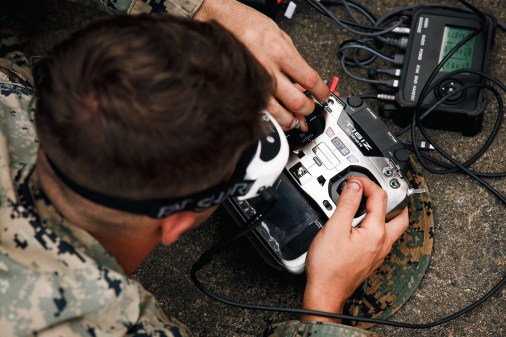
A ground control station and related components can add 30 pounds of weight to a soldier’s regular gear. Managing drone systems can also drain attention away from a unit’s primary combat focus, he said, adding these are “pain points we’re working through.”
The defense industry must also develop new approaches to making autonomous vehicles more fault-tolerant, resilient and survivable, added Bill Tecos, Director of Software and Cyber Engineering at General Dynamics Land Systems.
“Software is no longer about ‘smart platforms.’ It’s about ecosystems as capability and interoperability become the dominant drivers, especially for our modernization efforts such as XM30 and M1E3,” he said. “So, as we transition into (a scalable autonomous ecosystem), software-defined platforms are critical to what we must deliver every day.”
Tecos noted that, as defense partners roll out survivability upgrades, they need to focus on a combination of frequency, reliability, speed and adaptability. “Software can change behavior. It can change roles. It can change tactics. We need to be thinking of the mission as a configurable payload that can change to meet the need.”
As software increasingly defines modern tactical vehicles, industrial developers and government partners must collaborate through open application programming interfaces (APIs) to give remote units the flexibility they need, as demonstrated at Operation Jailbreak, Tecos said.
This article was produced by Scoop News Group for DefenseScoop and sponsored by GDIT.