Feinberg’s new Maven directive sets AI-enabled decision-making as ‘the cornerstone’ for CJADC2

The Maven Smart System is increasingly at the heart of the U.S. military’s plan to fuse all its sensors and assets across a single, flexible network, Deputy Defense Secretary Steve Feinberg suggested in a March 9 memorandum that elevates Palantir’s widely-used software platform to an official Pentagon program of record.
“Transitioning MSS to a POR will provide the stable funding and resourcing necessary for deliberate, sustained development and enterprise-wide integration to give our commanders the [command and control, or] C2 necessary to fight and win wars,” Feinberg wrote in the memo, which was obtained by DefenseScoop.
This new designation sets MSS on an accelerated path to broader adoption across the joint force.
But less than a month after Feinberg’s edict, and at a time when Maven is supporting high-stakes, day-to-day military operations around the world, experts said the full implications of this major transition remain unclear.
“You would hope that the Pentagon would take advantage of this and be able to talk about how they’re doing things the right way,” a former senior defense official said. “But I think there’s a lack of transparency.”
Project Maven to MSS
In his four-page memo to senior Defense Department and military leaders, Feinberg wrote that “making MSS a POR will help mature this critical, AI-enabled system from a promising initiative into an enduring, joint, and fully supported capability that reliably delivers decision advantage across all domains.”
If all goes to plan, the platform will become a formal program of record before the end of this fiscal year in September.
At that point, MSS will have a dedicated funding line in the defense budget and be included in the Future Years Defense Program (FYDP) that arrays total DOD resources and force structure over a five-year period.
“So, being designated as a program of record means Palantir’s MSS is now in as permanent a position as a program can get within the DOD,” said Virginia Burger, a senior defense policy analyst at the Project on Government Oversight.
Burger, who previously served for almost a decade as an active-duty Marine Corps officer, said she suspected this transition of MSS into a program of record was forthcoming, based on deployment expansions and contract increases announced over the last year.
“As with everything that touches the DOD and AI, I always want to point out that we should all be wary and take a closer look at the ties these tech barons hold to the Trump administration,” Burger said. “[Palantir Chairman] Peter Thiel is incredibly close to the vice president.”
Over the last few years, the company has expanded its business with the public sector, and also works with the Department of Homeland Security, IRS and other government agencies.
“The personal ties of its leadership should not be excluded when considering how these things all interplay and drive decisions,” Burger said.
The Defense Department inked the initial $480 million, five-year IDIQ contract with Palantir for Maven in May 2024. At that time, executives at Palantir told reporters that the work under that contract would initially cover five U.S. combatant commands: Central Command, European Command, Indo-Pacific Command, Northern Command/NORAD, and Transportation Command.
Then, in May 2025, DOD revealed its decision to increase that contract ceiling for MSS to nearly $1.3 billion through 2029 — a move that officials said was made in anticipation of future demand.
“Now, as this Pentagon brings the Maven Smart System to a real program of record, it’s going to solidify the funding stream. But they’ve already said they want to accelerate AI. They want to get it up, and out to the commands,” journalist and author Katrina Manson told DefenseScoop. “So in a sense, it’s things that were already happening, but clearly this second Trump administration wants to go a lot faster and is very aggressive about that.”
Published last week, Manson’s new book Project Maven: A Marine Colonel, His Team, and the Dawn of AI Warfare is an investigative narrative based on more than 200 interviews with Maven insiders and opponents that captures the DOD’s secretive, yearslong effort to integrate AI into warfare.
Pentagon leadership under the first Trump administration originally launched Project Maven in 2017 to expand personnel’s adoption of AI-enabled technologies that autonomously detect, tag and track objects or humans of interest from images or videos taken by surveillance aircraft, satellites and other means.
Around 2022, responsibilities for most of the program’s elements started to split between the National Geospatial-Intelligence Agency (NGA) and the Pentagon’s Chief Digital and AI Office (CDAO), while certain duties moved over to the Office of the Undersecretary of Defense for Intelligence and Security.
All three organizations have been largely tight-lipped about Maven — and the associated industry-made MSS capabilities — since that transition.
According to a Palantir press release published in 2024, “Project Maven transitioned to NGA in 2023, where it became a Program of Record called Maven. Maven provides the cloud infrastructure, software capabilities, and AI that powers CDAO’s Combined Joint All-Domain Command and Control (CJADC2) initiatives.”
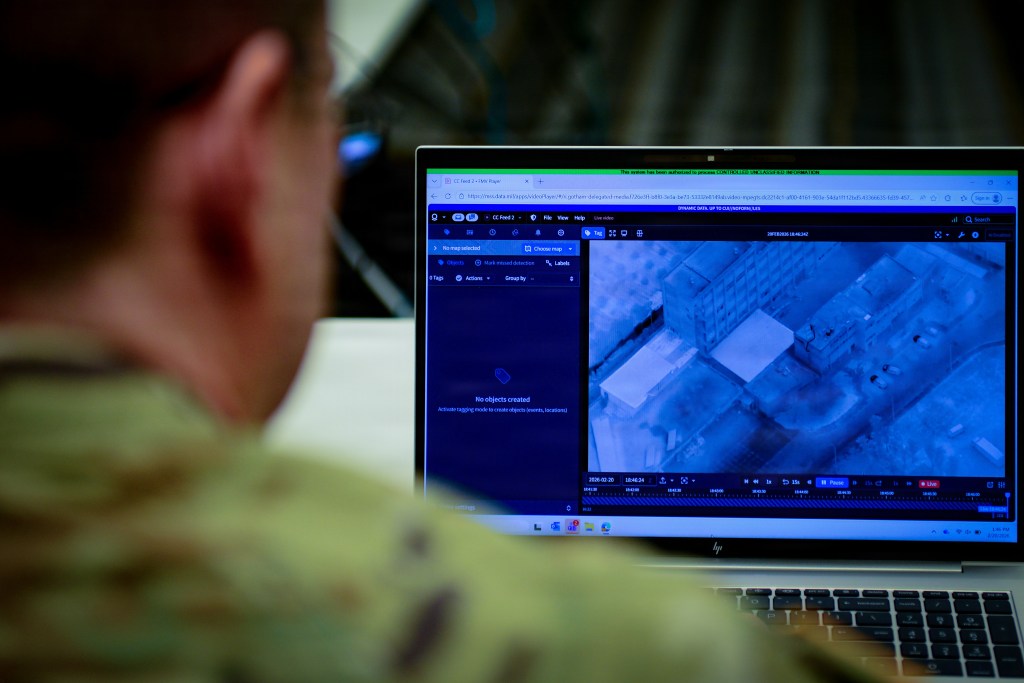
Feinberg’s latest memo that shifts MSS to a program of record includes explicit directions for the undersecretariats for Intelligence and Security, and Research and Engineering, to coordinate and oversee the “transition of MSS system administration, oversight, support activities, and related responsibilities from NGA to the CDAO MSS Program Office.”
Among other tasks, the directive also instructs R&E to assume authorizing official (AO) responsibilities from the NGA for MSS and its associated commercial cloud enterprise infrastructure.
A spokesperson from NGA referred DefenseScoop’s questions about the turnover process — and specifically, how this latest transition differs from the earlier one for Maven in 2023 — to the Pentagon.
A Pentagon official told DefenseScoop they “decline to comment [on that matter] citing operations security.”
Experts who spoke to the publication expressed dissatisfaction with the department’s response, noting that MSS is reaching a pivot point with ever-expanding use, where transparency and oversight are becoming even more critical.
“There’s always an OPSEC consideration. But if you’re that worried about OPSEC, you wouldn’t be showing these videos every day about how many targets you’re hitting,” the former senior defense official said, referring to Defense Secretary Pete Hegseth’s online posts of U.S. strikes against Iran amid Operation Epic Fury. “So, I think it’s a lost opportunity, and I think the press should just hound the shit out of them.”
They said they will be watching to see whether and how this transition of MSS to a program of record will tie Palantir’s products further into the military’s C2 architecture.
“I’ll be interested to see how much they’re trying to turn this into a command-and-control platform, versus a situation awareness, info-sharing, intelligence and operational picture platform. Those are two fundamentally different things,” the former senior defense official told DefenseScoop. “As a program of record it could, in theory, start being used as a command-and-control platform — like doing targeting off of it, rather than just coming up with targets and then turning them over to humans for review. That’s a big deal.”
‘Gnarly questions’
Combined Joint All-Domain Command and Control, or CJADC2, refers to DOD’s overarching concept to connect all the U.S. military’s sensors, weapons, and decision-makers across air, land, sea, space and cyberspace, and seamlessly move data across the services and with coalition partners.
“In order to maintain our data-driven decision advantage, it is imperative that we invest now and with focus to deepen the integration of [AI] across the Joint Force and establish AI-enabled decision-making as the cornerstone of our strategy for [CJADC2],” Feinberg wrote in the March 9 memo. “This technological opportunity requires that we re-focus the management of our CJADC2 capability buildout efforts across the Joint Force.”
He directed Undersecretary for R&E and Pentagon Chief Technology Officer Emil Michael to prepare a plan for his immediate review “to rationalize governance and accelerate” the DOD’s ongoing buildout of the capability.
“This ‘CJADC2 Acceleration Plan’ shall assess the scope, feasibility, and necessity of establishing a CJADC2 Direct Reporting Program Manager for the Department to oversee, rationalize, and accelerate CJADC2 efforts Department-wide with clear accountability for results,” Feinberg wrote.
That new plan will also evaluate the option of aligning the MSS program of record “under a potential CJADC2 Program Office as its permanent home,” he noted.

In the near term, the Pentagon will consolidate associated administration and oversight responsibilities into the CDAO MSS Program Office, which will lead Maven until the CJADC2 Acceleration Plan is approved.
“As we discussed, it looks to me like the intent is to bring MSS under CJADC2 eventually. If that happens, what will matter most will be whether Palantir tries to make this ‘the’ C2 platform — the platform of platforms, so to speak,” the former senior defense official told DefenseScoop. “That would lock them in for a decade.”
They said that they are “also not against the idea of a CJADC2 Direct Reporting Program Manager” for the department.
“That would give it the priority it needs, establish necessary accountability, which seems to have been missing, and will force some much-needed priority calls,” the former senior defense official noted. “So all in all, I’m in favor of the proposals. It will all come down to execution.”
Others who spoke to DefenseScoop also noted the memo’s inclusions that suggest MSS could become a primary platform under a CJADC2-style office, and potentially evolve into a central, digital operational environment where different services and commands plan, coordinate and execute operations.
“It’s hard to understate how important this program — well, what is now a program — is, how much it’s grown, what an important role it’s playing, and what an important potential role it has,” said Emelia Probasco, a senior fellow at Georgetown’s Center for Security and Emerging Technology (CSET).
Among other positions, Probasco previously served as a surface warfare officer in the Navy and in the Pentagon as the speechwriter to the chief of naval operations.
“MSS is a great potential tool, but it comes with some really gnarly questions. And I think we’re starting to wander into things that Congress would want to have more oversight on,” she told DefenseScoop.
Probasco noted that there’s bureaucratic logic supporting MSS gaining program-of-record status.
“The reason that you need a program of record isn’t because you actually need a program of record. It’s because you needed to send a signal to the services that it was time to take care of all the training and maintenance. And so the reason there was this compute gap, and there’s not formalized training, is just because it wasn’t a program of record,” she said. “And all of the ‘DOTMLPF-P’ sort of tasks don’t really kick off until they see that something is a program of record.”
DOTMLPF-P refers to a DOD framework to identify and resolve capability gaps across doctrine, organization, training, materiel, leadership, personnel, facilities and policy.
“But one of the things that we’ve been thinking a lot about is that Maven becomes unbelievably successful because it has very little structure,” Probasco said. “So this, like, amazing growth that it’s experienced, we don’t think it would have experienced that growth had it been a program of record earlier in its lifecycle.”
She and other experts agreed the MSS transition positions Palantir as a leading AI beneficiary in the U.S. defense sector.
“I think Palantir wanted it to be a program of record. I would imagine it’s pretty good for business. I think somebody needed to light a fire under the services’ butts to get moving, and a program of record is a good way to do that. But in summary, it wasn’t necessary. And so now we have to really watch, is this going to squash the innovation that has made Maven so amazing and so popular?” Probasco said.
A Palantir spokesperson told DefenseScoop that the company “is proud to support our armed forces,” and referred all questions on Maven to the Pentagon.
“The Pentagon will continue to rapidly deploy frontier AI capabilities to the warfighter through strong industry partnerships across all classification levels,” a Pentagon official said.
However, they declined to comment on whether MSS will become the centerpiece for the department’s CJADC2 work.
“I think there’s some serious governance questions that need to be asked, as you have been. I wouldn’t give up on that. I’d keep poking and prodding people,” the former senior defense official noted.
Other experts also said they’ll push for more transparency into MSS funding and use amid this elevation and its potential move into a core command-and-control platform.
“What happens to NGA’s Maven is a question for me that I’ll be pursuing — and in theory, I think, according to the way it’s written, nothing would change. But let’s both check,” Manson told DefenseScoop.